LAGOS STATE MODEL PRIMARY SCHOOL
ONE YEAR PRE-PRIMARY EDUCATION CURRICULUM - TEACHING NOTES
Level: Pre-primary Teacher: ……………………………… Domain: Cognitive Development
Sub-Domain: Measurement
Indicators (Developmental Expectations)
• Uses everyday mathematical language to describe time and sequence in daily routines.
Teacher Background Notes
For pre-primary children, "measurement" of time does not begin with reading minutes and hours on a digital screen. Instead, it is rooted in understanding the flow, sequence, and patterns of their daily lives. Young children make sense of time by linking it to concrete, repetitive events—such as waking up, eating breakfast, coming to school, going home, and sleeping.
As a teacher, your goal is to help children acquire and use temporal language (e.g., "before", "after", "first", "next", "then", "morning", "afternoon", "night") to organize their thoughts and describe their world. By connecting these abstract mathematical concepts to their immediate Nigerian home and school routines, you make learning natural, intuitive, and deeply relational.
Activity Guidance
Activity 1: Morning and Closing Circle (Action Songs & Routines)
1. Introduction: Gather the children in a circle to start the day. Introduce the "Circle Can". Shake the can and tell the children that inside are special song cards that tell us about our day.
2. Demonstration & Guided Practice: Pull out a card with a sun on it. Lead the children in an energetic morning action song, such as:
“Good morning, good morning, the sun is shining bright! We wash our face, we brush our teeth, and wave the night goodbye!”
Ask the children: "What did you do first before coming to school today?" Encourage answers like, "I bathed first," or "First, I ate my pap."
3. Transition to Afternoon/Closing: At the end of the school day, gather the children again. Pull out a card with a moon or a home symbol. Sing a closing song:
“Tick-tock, tick-tock, school is over now! We go to our homes, we see our parents, and wave goodbye to school!”
Discuss what they will do next when they get home (e.g., change clothes, eat lunch, take a siesta).
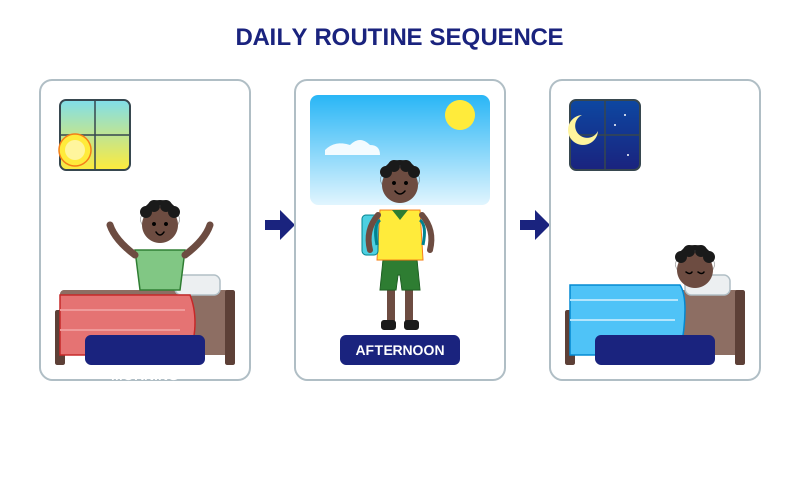 |
A detailed, colourful SVG illustration showing a sequence of... |
Activity 2: Play Clock in the Home-Area (Pretend Play)
1. Introduction: In the socio-dramatic (home-area) play corner, introduce the "Old Clock with Movable Hands." Explain to the children that this is a play clock we use to tell our family when it is time to do different things.
2. Demonstration: Move the hands of the clock to 12 o'clock. Say, "Look! My clock says it is afternoon. It is time to cook amala for lunch!" Pretend to stir a pot in the play kitchen.
3. Guided Play: Invite children in pairs to play with the clock. One child moves the hands, and the other decides what routine happens at that time. Encourage them to use sequencing language: "First, I will move the clock to night. Next, we must lie down on the mat and sleep."
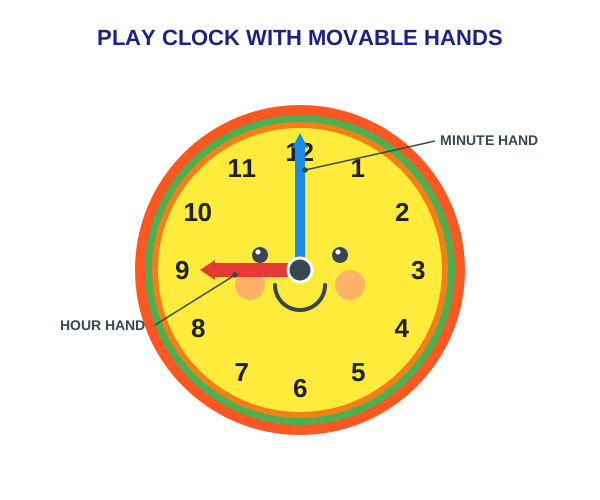 |
A detailed SVG schematic of a colourful educational play clo... |
Sample Resources and How to Use Them
• Circle Can with Song Cards:
How to use: Take an empty, clean powdered milk tin (e.g., Peak or Dano tin) and decorate it with bright paper. Cut out circular cardboard cards that fit inside. On each card, draw a simple icon: a rising sun (morning), a school bell (school time), a plate of food (lunch/afternoon), and a crescent moon with stars (night). Use this during circle time to let children take turns drawing a card to determine which part of the daily routine the class will sing about or discuss.
• Old Clock with Movable Hands:
How to use: Use a discarded wall clock or construct one using a circular piece of thick carton. Cut out two distinct hands (a short one for hours, a long one for minutes) from coloured plastic or cardboard, and secure them to the centre with a split pin so they can turn easily. Place this in the home-area. Children use it to act out household routines, turning the hands to simulate "sleeping time", "eating time", or "playtime".
• Daily Routine Picture Cards:
How to use: Create a set of durable, laminated flashcards depicting a child's typical day in Nigeria. Card 1: Waking up/sweeping. Card 2: Eating breakfast. Card 3: Walking to school. Card 4: Sitting in class. Card 5: Playing football/games in the afternoon. Card 6: Sleeping on a mat or bed. Use these cards for individual and small-group sequencing games where children arrange them in order from morning to night.
Supporting Children at Different Levels
Unseen: Children at this level do not yet use time-related words or understand the order of daily events. Support them by heavily narrating their immediate actions. Use physical gestures and point to the daily routine picture cards. For example, say: "Look, first we wash our hands. Next, we sit down to eat. See? First, hand washing. Next, eating." Keep sequences simple, focusing on just two steps at a time.
Progressing: Children at this level understand the general sequence of the day but may occasionally mix up terms (e.g., saying "I slept in the afternoon" when they mean night, or getting confused between "before" and "after"). Support them by asking guiding questions during play: "You have the school card and the sleeping card. Do we go to school before we sleep, or after we sleep?" Encourage them to use the words "first" and "then" to explain their choices.
Mastered: Children at this level confidently use words like "first", "next", "before", "after", "morning", "afternoon", and "night" to describe their entire day. Challenge them by adding more cards to their sequencing tasks (e.g., introducing "evening" activities like family storytelling or washing feet before bed). Ask them open-ended questions: "What would happen if we tried to put on our shoes before our socks?" to deepen their logical thinking about sequence.
Observation and Evaluation Guide
When assessing the children during circle time, play-centre activities, or small-group work, look for and record the following:
• Sequencing Ability: Can the child arrange three daily routine picture cards (morning, afternoon, night) in the correct chronological order?
• Use of Temporal Language: Does the child spontaneously or responsively use words like "first", "next", "before", "after", "morning", "afternoon", and "night"?
• Understanding of Time Transitions: When playing with the play clock, does the child associate specific clock movements or positions with corresponding daily activities (e.g., pointing to the moon card when the clock hands are moved to "bedtime")?
Common Difficulties and Teacher Responses
• Difficulty: Confusion between "Yesterday", "Today", and "Tomorrow".
Teacher Response: These are highly abstract terms. Avoid teaching them in isolation. Instead, create a simple "Our Week" board with three pockets labelled "Yesterday", "Today", and "Tomorrow". Every morning during circle time, physically move a picture card of a major classroom event (like "We painted" or "We will play outdoor games") between the pockets while saying: "Yesterday, we painted. Today, we are writing. Tomorrow, we will play outside."
• Difficulty: Thinking "Night" only begins when they close their eyes to sleep.
Teacher Response: Children often miss the transition of evening. Use picture cards that show evening activities common in Nigerian homes, such as eating dinner with family, washing up, or listening to bedtime stories. Explain that evening is the quiet time when the sun has gone down, which comes before we finally close our eyes to sleep at night.