TOPIC: MATTER, ELEMENTS, COMPOUNDS AND MIXTURES
SUBTOPICS: Heating and Cooling curves of matter, Elements, Compounds
SPECIFIC COMPETENCES
1. Construct the heating and cooling curves of matter
2. Demonstrate understanding of elements in everyday life
3. Demonstrate understanding of compounds
INTRODUCTION
Chemistry is the study of matter, its properties, composition, and how it changes. All substances around us, from the air we breathe to the food we eat and the devices we use, are made of matter. In this unit, we will explore the different states of matter, how they change with temperature, and the fundamental building blocks of all substances: elements and compounds.
CORE CONCEPTS
1. HEATING AND COOLING CURVES OF MATTER
Matter exists in different states: solid, liquid, and gas. These states can change depending on the amount of heat energy gained or lost by the substance.
• Kinetic Theory of Matter: This theory states that all matter is made up of tiny particles (atoms, molecules, or ions) that are in constant, random motion. The degree of movement of these particles depends on their temperature.
* In a solid, particles are tightly packed in a fixed, regular arrangement and vibrate about fixed positions. Solids have a fixed shape and volume.
* In a liquid, particles are closely packed but can move past each other randomly. Liquids have a fixed volume but no fixed shape, taking the shape of their container.
* In a gas, particles are far apart and move rapidly and randomly. Gases have neither a fixed shape nor a fixed volume, expanding to fill their container.
A heating curve is a graph that shows how the temperature of a substance changes over time as it is continuously heated at a constant rate. Conversely, a cooling curve shows how the temperature of a substance changes over time as it continuously loses heat at a constant rate.
During a change of state (phase change), the temperature of the substance remains constant, even though heat is being added or removed. This is because the energy supplied (latent heat) is used to overcome the forces of attraction between particles, rather than increasing their kinetic energy (which would raise the temperature).
• Melting: The process where a solid changes into a liquid upon gaining heat energy. The temperature at which this occurs is called the melting point.
• Boiling: The process where a liquid changes into a gas (vapour) throughout the bulk of the liquid upon gaining heat energy. The temperature at which this occurs is called the boiling point.
• Freezing: The process where a liquid changes into a solid upon losing heat energy. The temperature at which this occurs is called the freezing point, which is usually the same as the melting point for a pure substance.
• Condensation: The process where a gas changes into a liquid upon losing heat energy.
• Sublimation: The direct change of state from solid to gas without passing through the liquid phase (e.g., dry ice, iodine).
• Deposition: The direct change of state from gas to solid without passing through the liquid phase (e.g., frost formation).
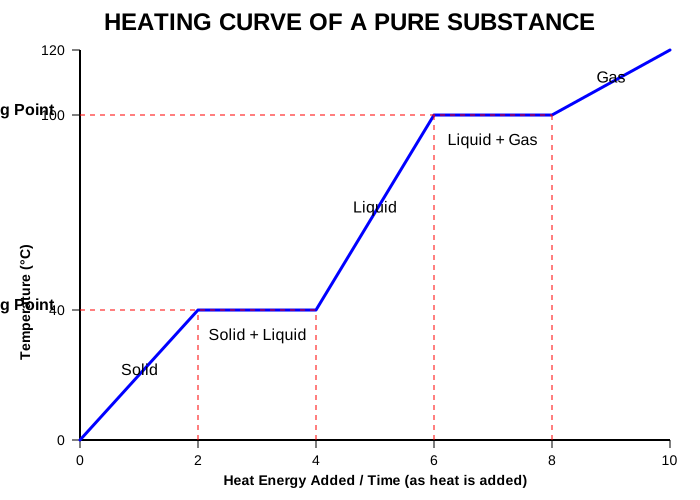 |
HEATING CURVE OF A PURE SUBSTANCE |
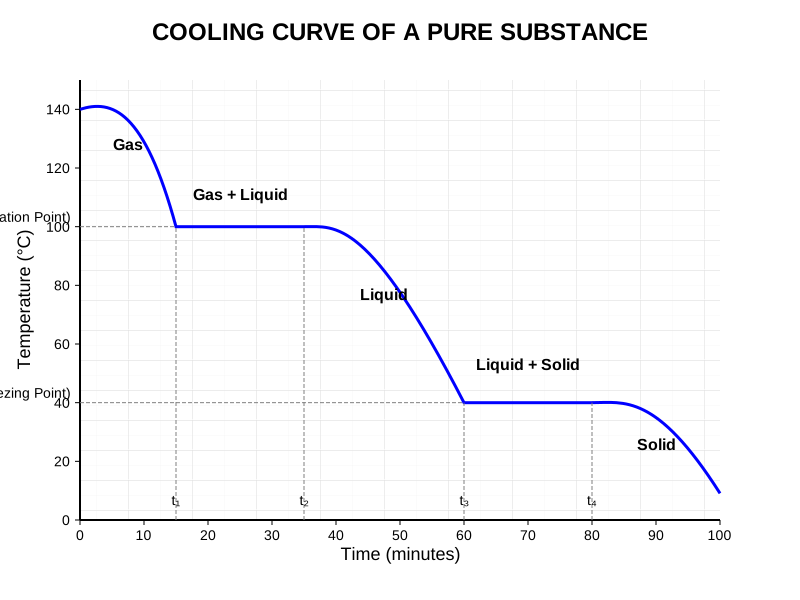 |
COOLING CURVE OF A PURE SUBSTANCE |
Interpreting Heating and Cooling Curves
Heating and cooling curves provide valuable information about a substance's physical properties.
• The flat segments (plateaus) indicate phase changes, where the substance absorbs or releases latent heat without a change in temperature.
• The melting point and boiling point can be read directly from the temperature values of these plateaus.
• The steepness of the slopes indicates the specific heat capacity of the substance in that particular phase; a steeper slope means a lower specific heat capacity (temperature changes quickly for a given heat input).
Worked Example: Interpreting a Heating Curve
A substance is heated at a constant rate, and its temperature is recorded over time. The heating curve shows a plateau at 50°C and another plateau at 120°C.
i. What is the melting point of the substance?
ii. What is the boiling point of the substance?
iii. What state(s) of matter exist at 70°C?
Solution
| Given: |
Plateau 1 at 50°C; Plateau 2 at 120°C |
| Find: |
Melting point, boiling point, state(s) at 70°C |
| i. Melting Point: |
The first plateau on a heating curve represents melting. |
| Answer i: |
Melting point = 50°C |
| ii. Boiling Point: |
The second plateau on a heating curve represents boiling. |
| Answer ii: |
Boiling point = 120°C |
| iii. State at 70°C: |
At 70°C, the substance has completed melting (at 50°C) but has not yet started boiling (at 120°C). |
| Answer iii: |
At 70°C, the substance is in the liquid state. |
Worked Example: Interpreting a heating curve
2. ELEMENTS
An element is a pure substance that cannot be broken down into simpler substances by ordinary chemical or physical means. It consists of only one type of atom.
• An atom is the smallest unit of an element that retains the chemical properties of that element. All atoms of a given element have the same number of protons.
Classifying Elements
Elements are broadly classified into two main categories:
• Metallic Elements: These are typically shiny, good conductors of heat and electricity, malleable (can be hammered into sheets), ductile (can be drawn into wires), and have high melting points. Examples in everyday life include:
* Copper (Cu): Used in electrical wires and plumbing.
* Iron (Fe): Used in construction, tools, and vehicles.
* Aluminium (Al): Used in beverage cans, aircraft, and cooking foil.
* Sodium (Na): A very reactive metal, found in salt (as an ion).
* Zinc (Zn): Used to galvanise iron to prevent rust.
• Non-metallic Elements: These are generally dull, poor conductors of heat and electricity (insulators), brittle in solid form, and have lower melting and boiling points compared to metals. Examples in everyday life include:
* Oxygen (O): Essential for respiration, found in the air we breathe.
* Carbon (C): Found in coal, graphite (pencils), diamonds, and all organic compounds.
* Sulphur (S): Used in matches, gunpowder, and vulcanisation of rubber.
* Nitrogen (N): Major component of air, used in fertilisers.
* Chlorine (Cl): Used as a disinfectant for water.
* Hydrogen (H): Most abundant element in the universe, a component of water.
Diagrammatic Representation of Elements
Elements can exist as individual atoms, diatomic molecules (two atoms of the same element bonded together), or in large metallic lattices.
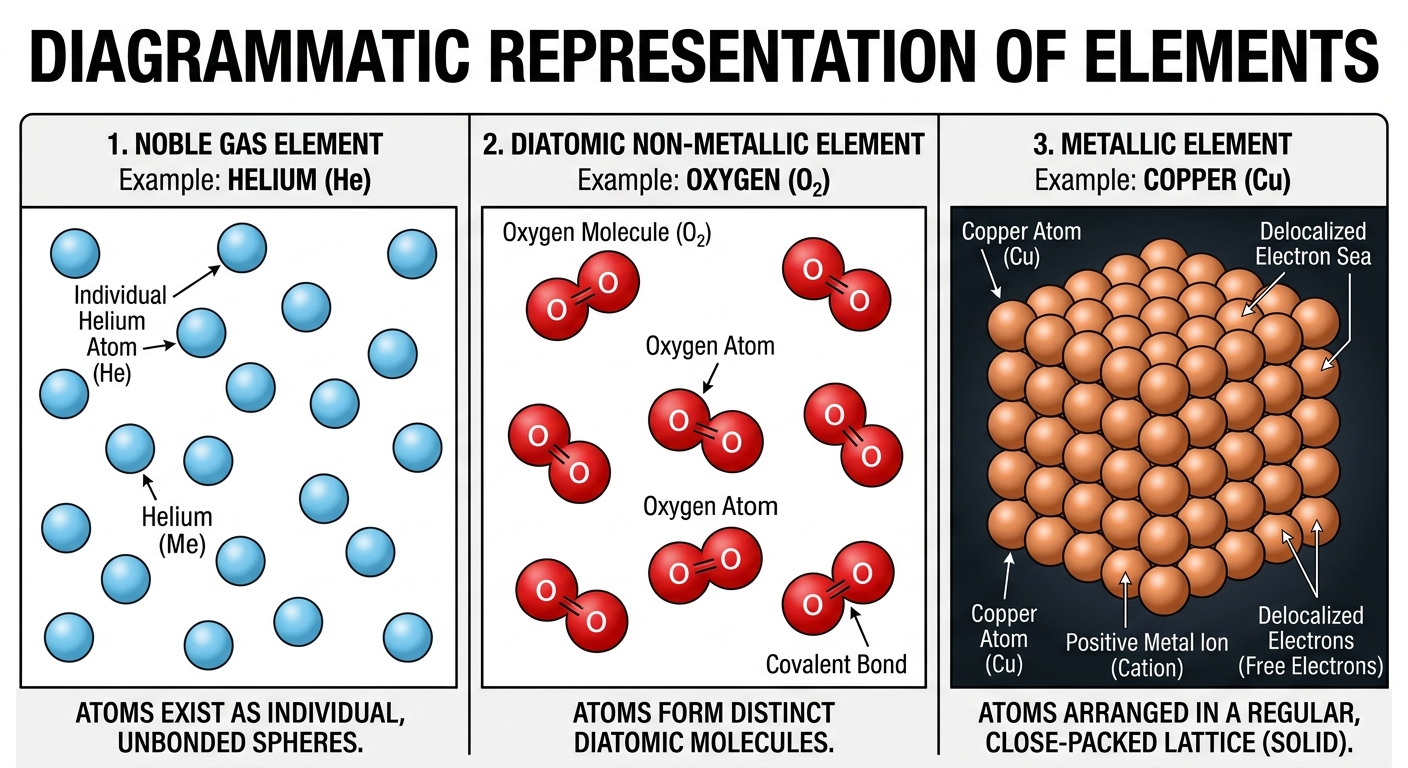 |
DIAGRAMMATIC REPRESENTATION OF ELEMENTS |
Electron Configuration in Shell Notation
The electron configuration describes the arrangement of electrons in the electron shells (energy levels) around the nucleus of an atom. For Form 1, we use a simplified shell notation (e.g., 2:8:1), where numbers represent the electrons in each successive shell from the innermost to the outermost.
• Sodium (Na): Atomic number 11. Electron configuration: 2:8:1 (2 electrons in the first shell, 8 in the second, 1 in the third).
• Chlorine (Cl): Atomic number 17. Electron configuration: 2:8:7 (2 electrons in the first shell, 8 in the second, 7 in the third).
• Oxygen (O): Atomic number 8. Electron configuration: 2:6 (2 electrons in the first shell, 6 in the second).
• Calcium (Ca): Atomic number 20. Electron configuration: 2:8:8:2 (2 electrons in the first shell, 8 in the second, 8 in the third, 2 in the fourth).
3. COMPOUNDS
A compound is a pure substance made up of two or more different elements chemically combined together in a fixed ratio. Unlike mixtures, compounds have entirely different properties from the elements they are made from. Chemical bonds hold the atoms together in a compound.
• For example, water (H2O) is a compound made from hydrogen and oxygen. Hydrogen is a flammable gas, and oxygen is a gas that supports combustion, but water is a liquid that extinguishes fires.
• The ratio of atoms in a compound is always fixed. For water, it is always two hydrogen atoms to one oxygen atom.
Exploring Various Compounds in Everyday Life
Compounds are ubiquitous and essential in our daily lives:
• Water (H2O): Essential for life, drinking, cleaning, cooking.
• Carbon Dioxide (CO2): Produced by respiration, used by plants for photosynthesis, contributes to climate change.
• Sodium Chloride (NaCl): Common table salt, used for seasoning food and preservation.
• Glucose (C6H12O6): A simple sugar, vital energy source for living organisms.
• Ammonia (NH3): Used in fertilisers and cleaning products.
• Sulphuric Acid (H2SO4): Used in car batteries and industrial processes.
• Calcium Carbonate (CaCO3): Found in limestone, marble, and eggshells.
Diagrammatic Representation of Compounds
Compounds are represented by their molecules or formula units, showing the different types of atoms bonded together.
 |
DIAGRAMMATIC REPRESENTATION OF COMPOUNDS |
Comparison: Elements vs. Compounds
Elements vs. Compounds
| Feature |
Elements |
Compounds |
| Composition |
Consist of only one type of atom. |
Consist of two or more different types of atoms chemically combined. |
| Breakdown |
Cannot be broken down into simpler substances by chemical means. |
Can be broken down into simpler substances (elements) by chemical means. |
| Properties |
Retain their own characteristic properties. |
Have entirely new properties different from their constituent elements. |
| Ratio |
No fixed ratio of different atoms (as there's only one type). |
Atoms are combined in a fixed ratio by mass. |
| Examples |
Oxygen (O2), Iron (Fe), Carbon (C) |
Water (H2O), Carbon Dioxide (CO2), Salt (NaCl) |
Figure: Comparison of elements and compounds
SUMMARY
• Matter exists as solids, liquids, and gases, with particles arranged and moving differently in each state.
• Heating and cooling curves illustrate phase changes, showing constant temperature during melting/freezing and boiling/condensation as latent heat is absorbed or released.
• An element is a pure substance consisting of only one type of atom and cannot be broken down chemically. They are classified as metals or non-metals.
• A compound is formed when two or more different elements are chemically combined in a fixed ratio, resulting in a new substance with unique properties.
ASSESSMENT QUESTIONS
1. Draw a labelled heating curve for a pure substance, clearly indicating the solid, liquid, and gaseous states, as well as the melting and boiling points.
2. Explain, in terms of the kinetic theory of matter, why the temperature of a substance remains constant during melting, even though heat energy is continuously supplied.
3. Classify the following substances as either a metallic element, a non-metallic element, or a compound:
* i. Aluminium foil
* ii. Oxygen gas
* iii. Table salt (Sodium Chloride)
* iv. Graphite
* v. Water
4. Describe two everyday uses for:
* i. A metallic element
* ii. A non-metallic element
* iii. A compound
5. Explain the key difference between an element and a compound in terms of their composition and how they can be broken down. Use examples to illustrate your answer.
6. Write the electron configuration in shell notation for an atom with atomic number 13 (Aluminium).
COMMON DIFFICULTIES & MISCONCEPTIONS
• Temperature during phase change: Students often struggle to understand why temperature does not change during melting or boiling. Emphasize that the energy is used to break intermolecular forces (latent heat), not to increase kinetic energy.
• Elements vs. Compounds: Confusing mixtures with compounds, or thinking that compounds retain the properties of their constituent elements. Highlight the chemical combination and fixed ratio for compounds, and the new properties.
• Molecular vs. Atomic elements: Some students may think all elements are individual atoms. Explain that non-metals like oxygen exist as diatomic molecules (O2) and metals exist as a lattice of atoms.
• Sublimation/Deposition: These direct phase changes are often overlooked or misunderstood. Provide clear examples like dry ice.
QUICK REFERENCE SUMMARY
Quick Reference: Matter, Elements & Compounds
| Matter |
Anything that has mass and occupies space. Exists as solid, liquid, or gas. |
| Kinetic Theory |
Particles are in constant motion; degree of motion depends on temperature. |
| Phase Change |
Transformation between states (melting, boiling, freezing, condensation, sublimation, deposition). Temperature remains constant during phase change (latent heat). |
| Element |
Pure substance made of one type of atom. Cannot be broken down chemically. (e.g., Copper, Oxygen) |
| Compound |
Pure substance made of two or more elements chemically combined in a fixed ratio. Has new properties. (e.g., Water, Carbon Dioxide) |
Figure: Key concepts in Matter, Elements and Compounds