TOPIC: ACIDS, BASES AND SALTS
SUBTOPICS: Characteristic properties of acids and bases
SPECIFIC OUTCOMES:
1. Describe acids, bases or alkalis in terms of ions they contain or produce in aqueous solution.
2. Describe the meaning of weak, strong, dilute and concentrated acids and alkalis.
3. Describe the pH scale.
4. Describe neutrality, acidity and alkalinity in terms of pH value.
5. Determine the pH value of a solution.
INTRODUCTION
Acids, bases, and salts are fundamental chemical compounds that play crucial roles in our daily lives, from the food we eat to the industrial processes that produce essential materials. Understanding their characteristic properties, how they behave in solution, and how their strength and concentration are measured is essential in chemistry. This unit will explore these properties, focusing on their ionic nature and the pH scale.
CORE CONCEPTS
1. ACIDS, BASES, AND ALKALIS IN TERMS OF IONS
• Acids
An acid is defined as a compound that produces hydrogen ions (H+) as the only positively charged ions in an aqueous solution. When an acid dissolves in water, it undergoes ionisation, releasing H+ ions. These H+ ions are responsible for the characteristic properties of acids. In reality, H+ ions are highly reactive and immediately combine with water molecules to form hydronium ions (H3O+). However, for simplicity, we often represent them as H+(aq).
Examples of acids and their dissociation equations:
* Hydrochloric acid: HCl(aq) → H+(aq) + Cl-(aq)
* Sulphuric acid: H2SO4(aq) → 2H+(aq) + SO42-(aq)
* Nitric acid: HNO3(aq) → H+(aq) + NO3-(aq)
• Bases
A base is generally defined as an oxide or hydroxide of a metal. This definition also includes ammonium hydroxide (NH4OH). Bases are proton acceptors. They can neutralise acids to form salt and water.
Examples of common bases:
* Copper(II) oxide (CuO) – a metal oxide
* Sodium hydroxide (NaOH) – a metal hydroxide
* Magnesium hydroxide (Mg(OH)2) – a metal hydroxide
* Ammonium hydroxide (NH4OH) – forms when ammonia gas (NH3) dissolves in water.
• Alkalis
An alkali is a soluble base that produces hydroxide ions (OH-) as the only negatively charged ions in an aqueous solution. All alkalis are bases, but not all bases are alkalis (because some bases are insoluble in water). The hydroxide ions (OH-) are responsible for the characteristic properties of alkalis.
Examples of alkalis and their dissociation equations:
* Sodium hydroxide: NaOH(aq) → Na+(aq) + OH-(aq)
* Potassium hydroxide: KOH(aq) → K+(aq) + OH-(aq)
* Calcium hydroxide: Ca(OH)2(aq) → Ca2+(aq) + 2OH-(aq)
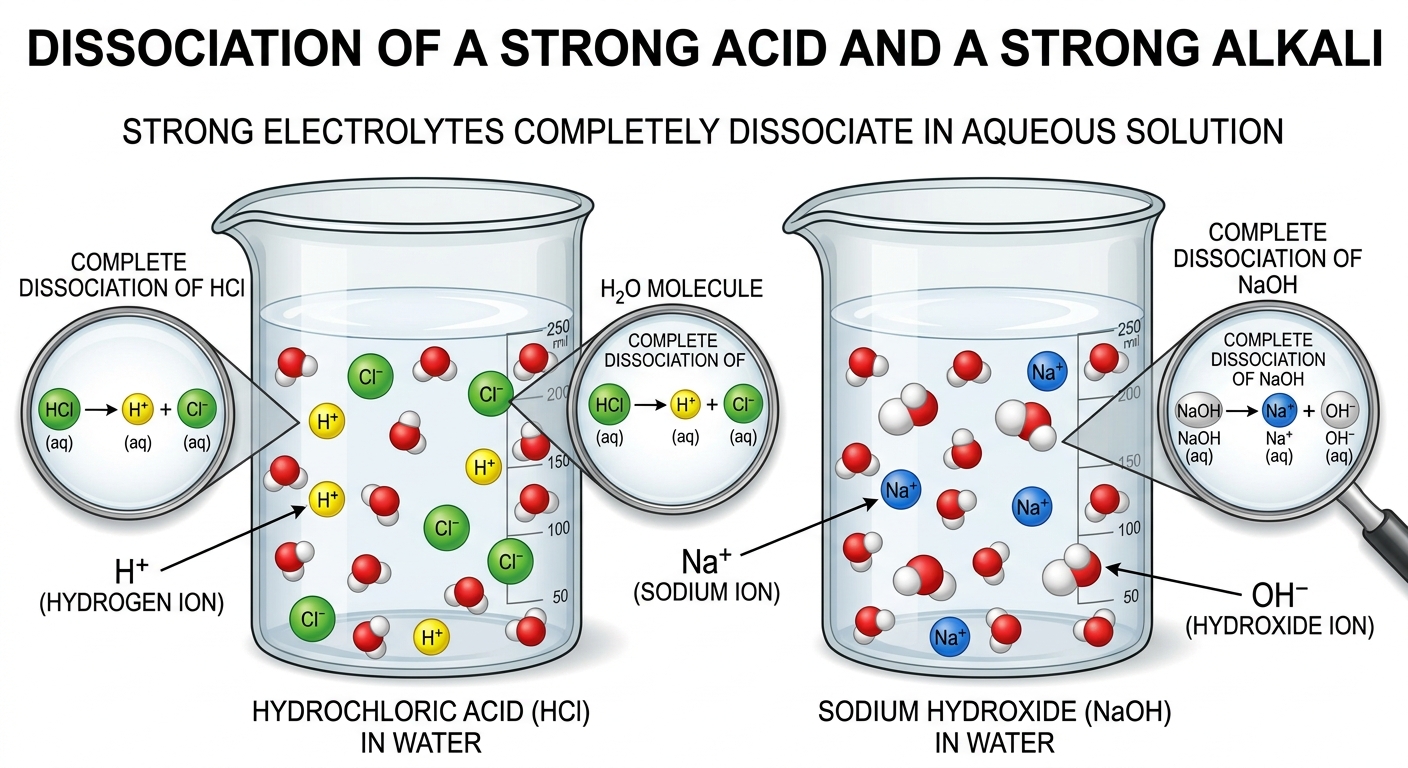 |
DISSOCIATION OF A STRONG ACID AND A STRONG ALKALI |
2. WEAK, STRONG, DILUTE, AND CONCENTRATED ACIDS AND ALKALIS
• Strength (Degree of Ionisation)
The strength of an acid or alkali refers to the degree of its ionisation (or dissociation) in an aqueous solution.
* Strong Acids: These are acids that completely ionise in water, meaning nearly all of their molecules dissociate to produce H+ ions. This results in a high concentration of H+ ions in the solution.
Examples: Hydrochloric acid (HCl), Sulphuric acid (H2SO4), Nitric acid (HNO3).
HCl(aq) → H+(aq) + Cl-(aq) (almost 100% dissociation)
H2SO4(aq) → 2H+(aq) + SO42-(aq)
* Weak Acids: These are acids that only partially ionise in water, meaning only a small fraction of their molecules dissociate to produce H+ ions. The dissociation is an equilibrium process.
Examples: Ethanoic acid (CH3COOH), Phosphoric acid (H3PO4), Carbonic acid (H2CO3).
CH3COOH(aq) ⇌ CH3COO-(aq) + H+(aq) (partial dissociation)
* Strong Alkalis (or Bases): These are alkalis that completely ionise in water, producing a high concentration of OH- ions.
Examples: Sodium hydroxide (NaOH), Potassium hydroxide (KOH), Calcium hydroxide (Ca(OH)2).
NaOH(aq) → Na+(aq) + OH-(aq)
* Weak Alkalis (or Bases): These are alkalis that only partially ionise in water, producing a low concentration of OH- ions.
Example: Ammonia (NH3) which forms ammonium hydroxide in water.
NH3(g) + H2O(l) ⇌ NH4+(aq) + OH-(aq)
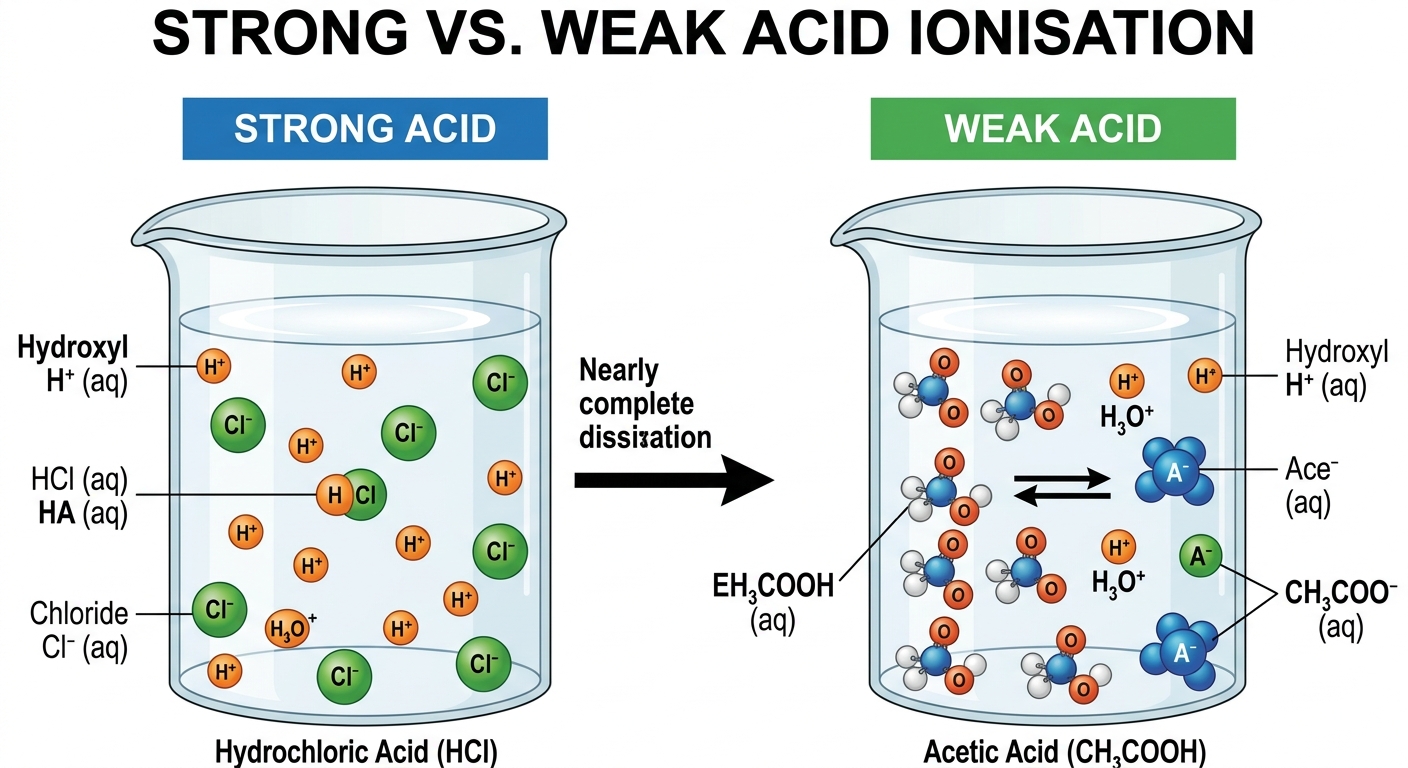 |
STRONG VS. WEAK ACID IONISATION |
• Concentration (Number of Ions per Volume of Solution)
The concentration of an acid or alkali refers to the amount of solute (acid or base) dissolved in a given volume of solvent (usually water). It is independent of strength.
* Concentrated Solution: Contains a large amount of solute dissolved in a given volume of solvent. For example, concentrated hydrochloric acid contains a high number of HCl molecules per unit volume.
* Dilute Solution: Contains a small amount of solute dissolved in a given volume of solvent. For example, dilute hydrochloric acid contains a low number of HCl molecules per unit volume.
It is important to note that a strong acid can be dilute, and a weak acid can be concentrated. For instance, a small amount of highly ionised HCl in a large volume of water would be a dilute strong acid. Conversely, a large amount of partially ionised CH3COOH in a small volume of water would be a concentrated weak acid.
3. THE pH SCALE
The pH scale is a numerical scale ranging from 0 to 14 that shows the degree of acidity or alkalinity of an aqueous solution. It is a measure of the hydrogen ion concentration (or hydronium ion concentration) in a solution. The 'p' in pH stands for 'power' or 'potential', and 'H' stands for hydrogen. Mathematically, pH is defined as the negative logarithm (base 10) of the hydrogen ion concentration:
pH = -log10[H+]
Where [H+] is the molar concentration of hydrogen ions.
4. NEUTRALITY, ACIDITY, AND ALKALINITY IN TERMS OF pH VALUE
The pH scale provides a convenient way to classify solutions:
• Neutrality: A neutral solution has a pH value of 7. In a neutral solution, the concentration of hydrogen ions ([H+]) is equal to the concentration of hydroxide ions ([OH-]). Pure water at 25°C is a neutral solution.
• Acidity: An acidic solution has a pH value below 7. The lower the pH value, the more acidic the solution, meaning it has a higher concentration of H+ ions. Strong acids have very low pH values (e.g., 0-2), while weak acids have slightly higher pH values (e.g., 3-6).
• Alkalinity (Basicity): An alkaline (or basic) solution has a pH value above 7. The higher the pH value, the more alkaline the solution, meaning it has a higher concentration of OH- ions and a lower concentration of H+ ions. Strong alkalis have very high pH values (e.g., 12-14), while weak alkalis have slightly lower pH values (e.g., 8-11).
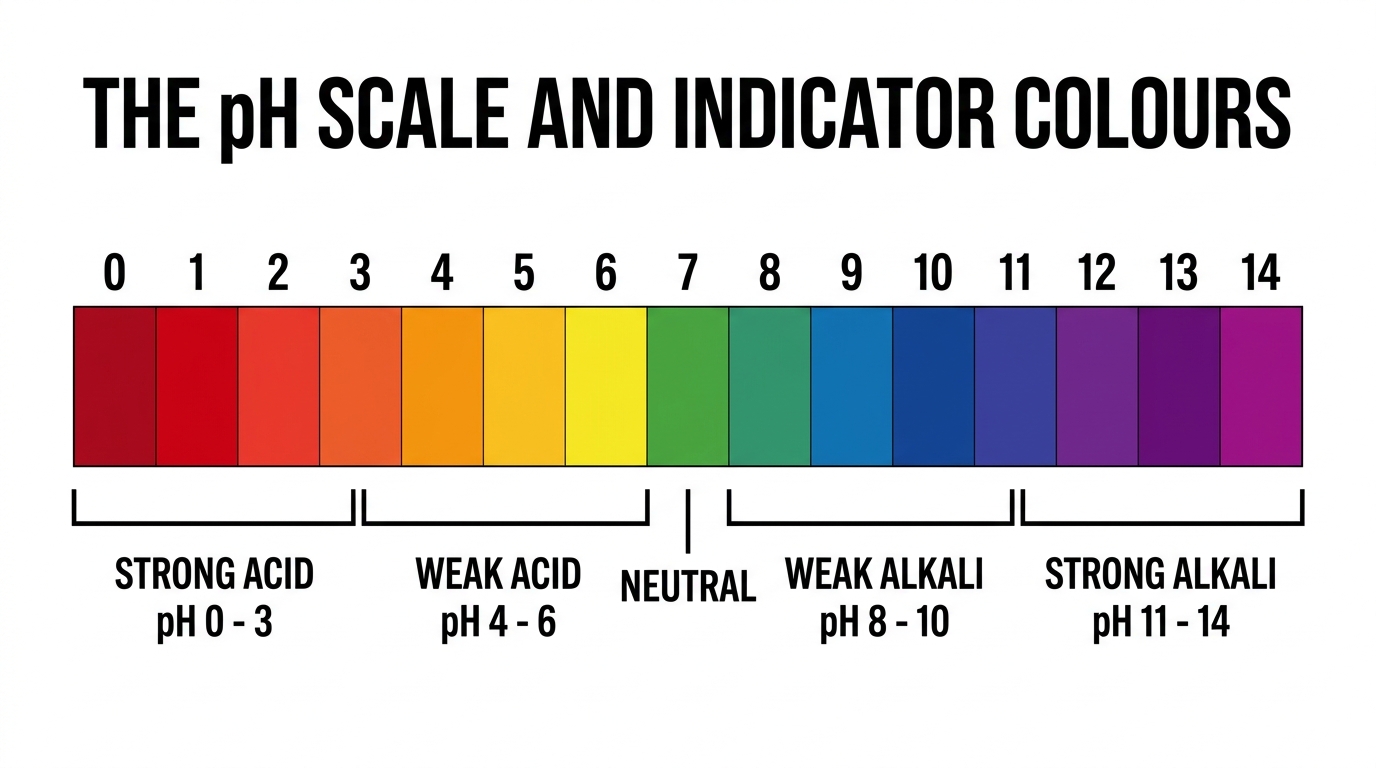 |
THE pH SCALE AND INDICATOR COLOURS |
5. DETERMINE THE pH VALUE OF A SOLUTION
There are two primary methods to determine the pH value of a solution in the laboratory:
• Using Universal Indicator
A universal indicator is a mixture of several different indicators that show different colours at different pH values. Unlike simple indicators like litmus paper (which only tells if a solution is acidic or basic), the universal indicator provides a more specific pH range by displaying a spectrum of colours.
When universal indicator solution or paper is added to a sample, its colour changes. This colour is then compared to a standard pH colour chart to determine the approximate pH value of the solution.
Universal Indicator Colour Chart
| pH Value |
Colour |
Strength/Nature |
| 0-2 |
Red |
Strong Acid |
| 3-4 |
Orange |
Weak Acid |
| 5-6 |
Yellow |
Weak Acid |
| 7 |
Green |
Neutral |
| 8-9 |
Blue |
Weak Alkali |
| 10-14 |
Violet/Purple |
Strong Alkali |
Figure: Universal Indicator colour chart showing pH values and corresponding colours.
• Using a pH Meter
A pH meter is an electronic device used for measuring the pH of a liquid. It consists of a special measuring electrode (usually a glass electrode) connected to an electronic meter that displays the pH reading digitally.
To use a pH meter:
1. Calibrate the pH meter using standard buffer solutions of known pH (e.g., pH 4, pH 7, pH 10).
2. Rinse the electrode with distilled water.
3. Immerse the electrode into the solution to be tested.
4. Wait for the reading on the display to stabilise. The displayed value is the precise pH of the solution.
pH meters offer much greater precision and accuracy compared to universal indicators.
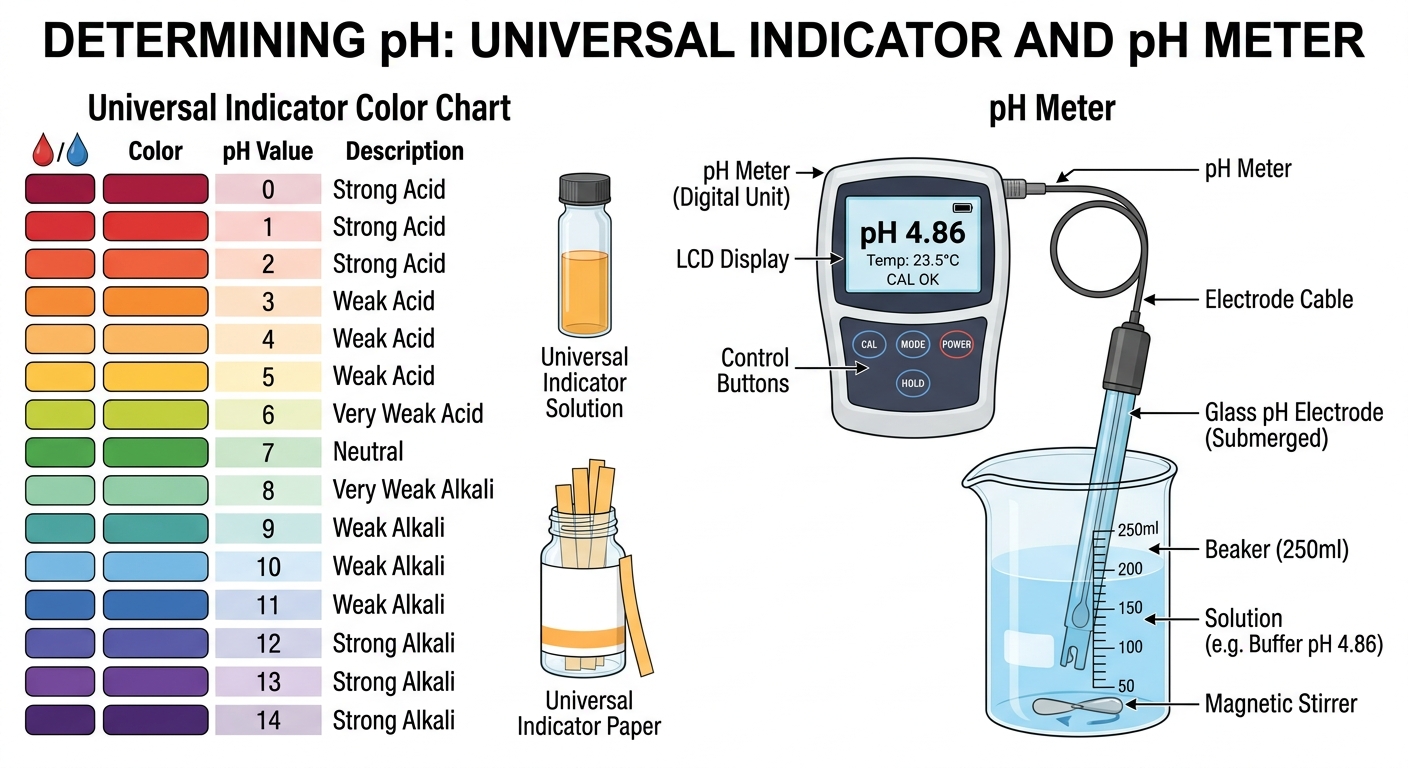 |
DETERMINING pH: UNIVERSAL INDICATOR AND pH METER |
SUMMARY
Acids are proton donors that produce H+ ions in aqueous solution, while bases are proton acceptors, often metal oxides or hydroxides. Alkalis are soluble bases that produce OH- ions in water. The strength of an acid or alkali depends on its degree of ionisation (complete for strong, partial for weak), whereas concentration refers to the amount of solute per volume of solution. The pH scale, ranging from 0 to 14, quantifies acidity (pH < 7), neutrality (pH = 7), and alkalinity (pH > 7). pH can be determined using universal indicators for approximate values or a pH meter for precise readings.
ASSESSMENT QUESTIONS
1. Which of the following statements correctly describes an acid?
A. A compound that produces hydroxide ions as the only negatively charged ions in aqueous solution.
B. A compound that produces hydrogen ions as the only positively charged ions in aqueous solution.
C. A soluble base that accepts protons.
D. A metal oxide that reacts with water to form a salt.
2. An alkali is best described as:
A. Any metal oxide.
B. An insoluble base.
C. A soluble base that produces hydroxide ions in aqueous solution.
D. A compound that produces H+ ions.
3. Which of the following is an example of a weak acid?
A. HCl
B. H2SO4
C. CH3COOH
D. HNO3
4. A student tests two solutions, P and Q. Solution P completely ionises in water, while solution Q only partially ionises. What can be concluded about P and Q?
A. P is a weak acid, Q is a strong acid.
B. P is a strong acid or alkali, Q is a weak acid or alkali.
C. P is a concentrated solution, Q is a dilute solution.
D. P and Q have the same strength but different concentrations.
5. What does the term "dilute acid" mean?
A. The acid is strong but has a low pH.
B. The acid has a low degree of ionisation.
C. There is a small amount of acid dissolved in a large volume of solvent.
D. There is a large amount of acid dissolved in a small volume of solvent.
6. A solution has a pH of 9. Which of the following describes this solution?
A. Strongly acidic.
B. Weakly acidic.
C. Neutral.
D. Weakly alkaline.
7. A solution turns green when universal indicator is added. What is its approximate pH value?
A. 2
B. 7
C. 10
D. 14
8. Describe how you would use a pH meter to determine the exact pH of an unknown solution. State two advantages of using a pH meter over a universal indicator.
9. Explain the difference between a "strong acid" and a "concentrated acid", providing an example for each.
10. Write balanced chemical equations to show the dissociation of:
a) Sulphuric acid (a strong acid) in water.
b) Potassium hydroxide (a strong alkali) in water.
c) Ethanoic acid (a weak acid) in water (use equilibrium arrows).
COMMON DIFFICULTIES & MISCONCEPTIONS
• Strength vs. Concentration: Students often confuse "strong" with "concentrated" and "weak" with "dilute". Emphasise that strength refers to the degree of ionisation, while concentration refers to the amount of solute. A strong acid can be dilute, and a weak acid can be concentrated.
• H+ and H3O+: While H+ is commonly used for simplicity, students should understand that in aqueous solutions, hydrogen ions exist as hydronium ions (H3O+).
• Definition of Base: Some students might only think of hydroxides as bases. Clarify that metal oxides (e.g., CuO, MgO) are also bases, even if they are insoluble in water and thus not alkalis.
• pH Scale Interpretation: Misinterpreting the inverse relationship between H+ concentration and pH (i.e., lower pH means higher H+ concentration and greater acidity).
• Universal Indicator vs. Litmus: Students may not fully grasp that universal indicator gives a range of pH values, whereas litmus only indicates acidic or basic nature.
QUICK REFERENCE SUMMARY
• Acid: Produces H+ (or H3O+) as the only positive ions in water. (Proton donor)
• Base: Metal oxide or hydroxide (including NH4OH). (Proton acceptor)
• Alkali: Soluble base that produces OH- as the only negative ions in water.
• Strength: Degree of ionisation.
* Strong: Complete ionisation (e.g., HCl, NaOH).
* Weak: Partial ionisation (e.g., CH3COOH, NH3).
• Concentration: Amount of solute per volume of solution.
* Concentrated: High amount of solute.
* Dilute: Low amount of solute.
• pH Scale: 0-14, measures H+ concentration.
* pH < 7: Acidic (higher H+ concentration).
* pH = 7: Neutral ([H+] = [OH-]).
* pH > 7: Alkaline (higher OH- concentration).
• Determining pH:
* Universal Indicator: Changes colour, provides approximate pH from chart.
* pH Meter: Electronic device, provides precise digital pH reading.