THE HUMAN BODY: THE DIGESTIVE SYSTEM
LEARNING OBJECTIVES
By the end of this topic, you should be able to:
• Describe what digestion is.
• Identify the main organs that make up the digestive system.
CORE CONCEPTS
WHAT IS DIGESTION?
When you eat food like nshima, rice, or vegetables, your body cannot use it straight away. The food needs to be broken down into smaller pieces. This important process is called digestion.
Digestion is the breaking down of food into tiny substances called nutrients that your body cells can use for energy, growth, and repair. Imagine eating a large cob of maize. Your body cannot use the whole cob. Digestion makes it small enough to enter your blood and go to your cells.
Nutrients are useful substances from food that your body needs to stay healthy and work well. Examples are carbohydrates, proteins, fats, vitamins, and minerals.
Your body uses different parts and chemicals to break down food. This process starts in your mouth and ends when waste leaves your body.
✅ Check Your Understanding
Pause here. Let learners attempt these before moving on.
| 1. Quick Recall [1 mark] |
Define the term 'digestion' in your own words. |
| 2. Apply the Concept [2 marks] |
Why is it important for food to be digested before your body can use it? |
| 3. Misconception Check |
True or False: The purpose of digestion is to get rid of waste from the body. Explain your answer. |
Answers
1. Digestion is the process where large food pieces are broken down into small nutrients.
2. Food must be digested so that the small nutrient particles can pass into the blood and be used by body cells for energy, growth, and repair.
3. False. Digestion breaks down food into nutrients. Getting rid of waste is a different process called excretion.
ORGANS OF THE DIGESTIVE SYSTEM
The digestive system is a group of organs that work together to digest food. Each organ has a special job to do. Let us look at the main organs.
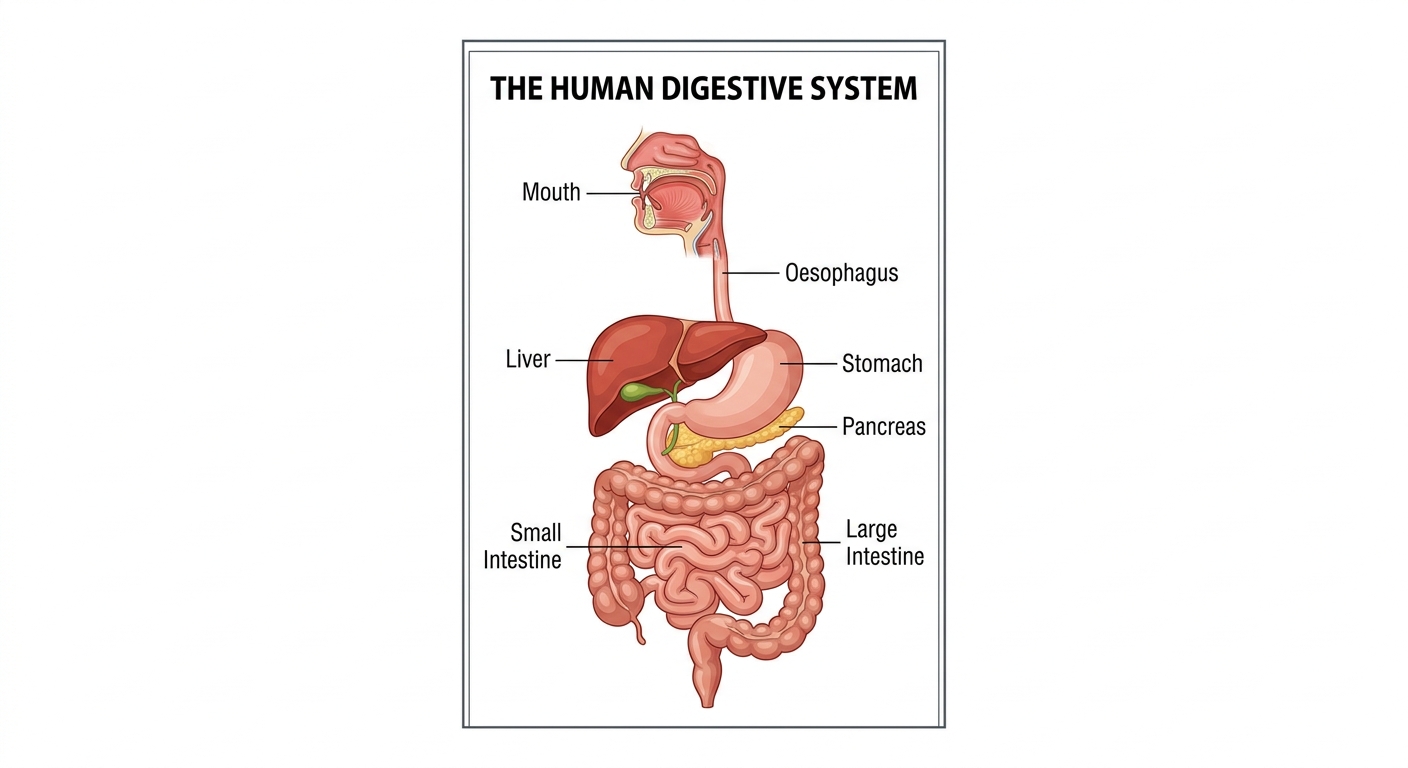 |
THE HUMAN DIGESTIVE SYSTEM |
1. Mouth: Digestion starts here. Your teeth cut and grind food into smaller pieces. Your tongue mixes the food with saliva (a liquid from glands in your mouth). Saliva helps to soften food and starts breaking down starch.
2. Oesophagus (Food Pipe): This is a tube that carries food from your mouth to your stomach. Muscles in the oesophagus push the food down.
3. Stomach: This is a bag-like organ. Food stays here for a few hours. The stomach churns the food and mixes it with strong digestive juices (stomach acid and enzymes). These juices break down proteins.
4. Liver: This is a large organ located near your stomach. It makes a liquid called bile. Bile helps to break down fats in the small intestine.
5. Pancreas: This organ is located behind the stomach. It produces important digestive juices (enzymes) that help break down carbohydrates, proteins, and fats. These juices flow into the small intestine.
6. Small Intestine: This is a very long, coiled tube. Most of the digestion happens here. All nutrients from your food are absorbed into your blood through the walls of the small intestine.
7. Large Intestine: This is a wider, shorter tube after the small intestine. It absorbs water from the undigested food. What is left becomes solid waste (faeces).
8. Anus: This is the opening at the end of the digestive system. Solid waste leaves your body through the anus.
THE JOURNEY OF FOOD
Food enters your mouth, where teeth chew it and the tongue mixes it with saliva. Then, you swallow. The food travels down the oesophagus to the stomach. In the stomach, food is mixed with strong juices. Next, the food moves to the small intestine. Here, most digestion and absorption of nutrients happen with help from juices made by the liver (bile) and pancreas (enzymes). Finally, undigested food goes to the large intestine, where water is absorbed. The solid waste leaves the body through the anus.
✅ Check Your Understanding
Pause here. Let learners attempt these before moving on.
| 1. Quick Recall [1 mark] |
Name two organs that help with digestion but food does not pass through them. |
| 2. Apply the Concept [3 marks] |
Imagine you eat a piece of chicken. Describe what happens to it in your mouth and stomach. |
| 3. Misconception Check |
Which statement is correct?
A. All food digestion happens in the stomach.
B. Most nutrient absorption happens in the small intestine.
Explain why the correct statement is true. |
Answers
1. Liver and Pancreas.
2. In the mouth, your teeth chew the chicken into smaller pieces. Your tongue mixes it with saliva. In the stomach, the chicken is churned and mixed with stomach acid and enzymes to break down its protein.
3. B. Most nutrient absorption happens in the small intestine. This is where digested food particles are small enough to pass through the walls into the bloodstream.
SUMMARY
• Digestion is the breaking down of food into tiny nutrients that your body can use.
• The main organs of the digestive system are the mouth, oesophagus, stomach, small intestine, large intestine, liver, and pancreas.
• Each organ plays a key role in breaking down food or absorbing nutrients.
PRACTICE QUESTIONS
1. Easy
* Name three organs of the digestive system.
* What is the purpose of digestion?
* Which organ produces bile to help digest fats?
2. Medium
* Describe the role of the mouth in digestion.
* Explain the difference between the small intestine and the large intestine in terms of their main functions.
* Put these organs in the correct order that food passes through them: stomach, mouth, large intestine, small intestine, oesophagus.
3. Hard
* Imagine you eat a meal of nshima with kapenta. Trace the path of this food through your digestive system, mentioning what happens in each major organ.
* Why is it important for the liver and pancreas to produce digestive juices, even though food does not pass through them?
FULL ANSWERS TO PRACTICE QUESTIONS
1. Easy
* Mouth, stomach, small intestine (any three from the list).
* The purpose of digestion is to break down large food particles into small nutrients that the body can absorb and use.
* The liver produces bile.
2. Medium
* In the mouth, teeth chew food into smaller pieces. The tongue mixes it with saliva, which softens the food and starts starch digestion.
* The small intestine is where most food is digested and most nutrients are absorbed into the blood. The large intestine mainly absorbs water from undigested food and forms waste.
* Mouth → Oesophagus → Stomach → Small Intestine → Large Intestine.
3. Hard
* When you eat nshima with kapenta:
* Mouth: Teeth chew the food, tongue mixes it with saliva. Starch in nshima starts to break down.
* Oesophagus: Food pipe pushes the food down to the stomach.
* Stomach: Food is churned and mixed with stomach acid and enzymes. Proteins in the kapenta start to break down.
* Small Intestine: Digestion finishes here with help from bile (from liver) and enzymes (from pancreas). All nutrients from nshima and kapenta are absorbed into the blood.
* Large Intestine: Water is absorbed from the undigested parts.
* The liver and pancreas are accessory organs. They produce important digestive juices (bile from the liver, enzymes from the pancreas). These juices flow into the small intestine to help break down fats, carbohydrates, and proteins. Without them, food cannot be fully digested.
COMMON MISTAKES TO AVOID
• Confusing digestion with excretion: Digestion is breaking down food. Excretion is getting rid of waste.
• Forgetting accessory organs: Remember that the liver and pancreas are part of the digestive system, even though food does not pass through them directly. They make important juices.
• Incorrectly naming organs: Make sure you know the correct names, like oesophagus (not just "food pipe").
• Thinking all digestion happens in the stomach: Most digestion and absorption happen in the small intestine.
EXAM TIPS
• Study the diagram: Be able to label all the main organs of the digestive system.
• Understand functions: Know what each organ does. For example, "mouth for chewing," "stomach for breaking down proteins."
• Remember the path: Trace the journey of food through the body.
• Learn key terms: Understand what digestion and nutrients mean.
QUICK REVISION SUMMARY
• Digestion: Breaking down food into nutrients.
• Nutrients: Substances body needs for energy, growth, repair.
• Organs: Mouth, oesophagus, stomach, small intestine, large intestine.
• Accessory Organs: Liver (makes bile), Pancreas (makes enzymes).
• Mouth: Chewing, saliva.
• Stomach: Churns food, breaks down proteins.
• Small Intestine: Most digestion and nutrient absorption.
• Large Intestine: Absorbs water.