INTRODUCTION
All objects around us are composed of atoms, which typically contain an equal number of positively charged protons and negatively charged electrons, rendering them electrically neutral. However, under certain conditions, objects can acquire an imbalance of these charges, leading to the phenomenon known as static electricity. Unlike current electricity, where charges flow continuously, static electricity involves charges that remain stationary or "static" on the surface of an object. This build-up of charges can manifest in various ways, from the simple act of a balloon sticking to a wall after being rubbed, to the dramatic spectacle of lightning during a thunderstorm. Understanding static electricity is fundamental to comprehending many electrical phenomena and its diverse applications in technology, as well as its inherent dangers.
SPECIFIC OUTCOMES
By the end of this unit, you will be able to:
• Demonstrate the existence of static charges, including positive and negative charges.
• Explain how to detect electric charges, including charging by contact and testing the sign of charge using a gold-leaf electroscope.
• Describe the properties and uses of static charges, specifically the law of electrostatics (like charges repel, unlike charges attract) and their applications in dust precipitators, inkjet printers, and photocopiers.
• Describe the electric charging and discharging of objects by friction and induction.
• Explain the relationship between current and static electricity, noting that static electricity can produce similar effects to current electricity.
• Investigate the effects of static charges on the environment, such as lightning.
CORE CONCEPTS
28.1 STATIC CHARGES
All matter is fundamentally composed of atoms. Each atom consists of a nucleus containing positively charged protons and neutral neutrons, surrounded by negatively charged electrons orbiting in shells. In a neutral atom, the number of protons equals the number of electrons, resulting in a net charge of zero.
Static Electricity is defined as the build-up of electrical charges on the surface of an object. These charges are considered 'static' because they remain at rest on the surface, rather than flowing continuously as in an electric current.
Objects become electrically charged when there is a transfer of electrons.
• If an object loses electrons, it will have more protons than electrons, thus becoming positively charged.
• If an object gains electrons, it will have more electrons than protons, thus becoming negatively charged.
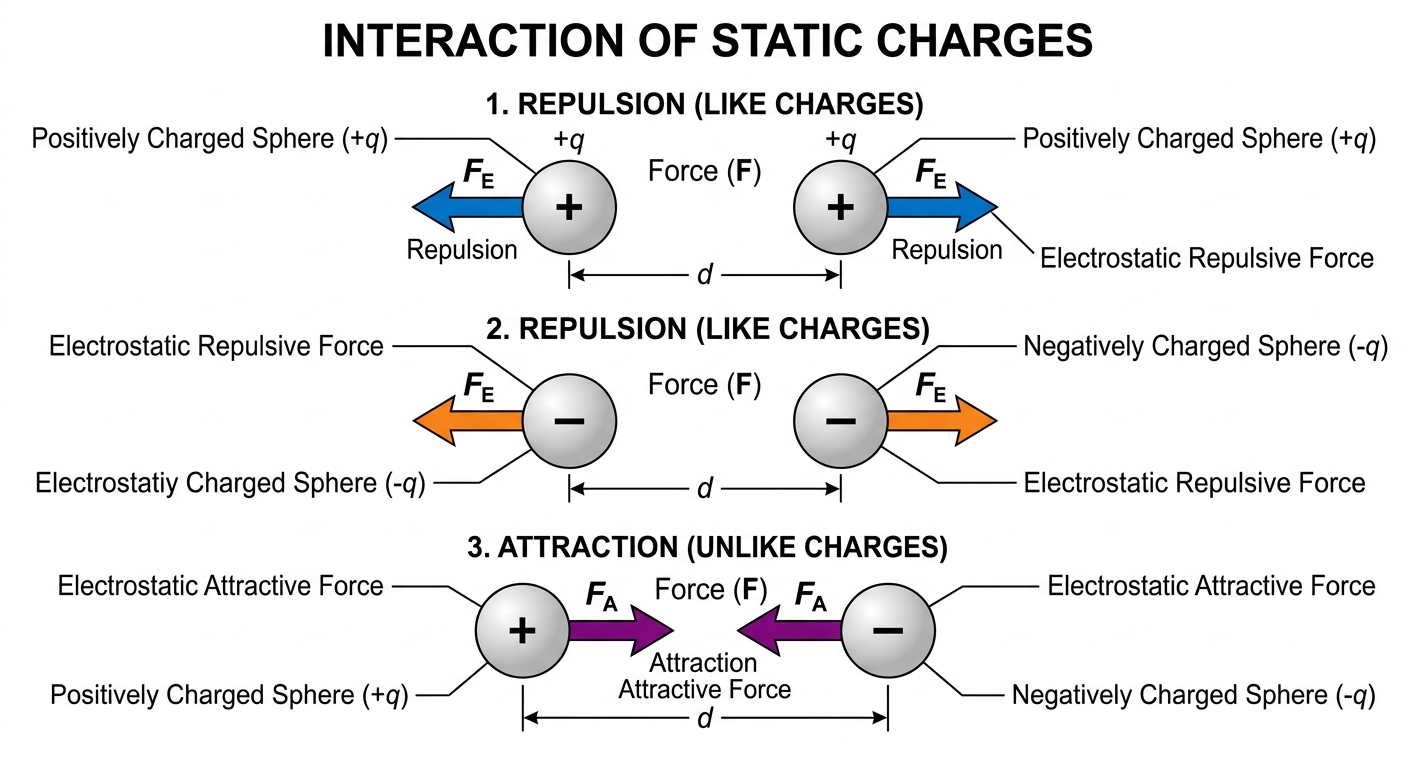
The fundamental interaction between these charges is governed by the Law of Electrostatics:
• Like charges repel each other: Two positive charges will push each other away, and two negative charges will also push each other away.
• Unlike charges attract each other: A positive charge and a negative charge will pull towards each other.
 |
INTERACTION OF STATIC CHARGES |
DEMONSTRATING THE EXISTENCE AND DETECTION OF STATIC CHARGES
The existence of static charges can be demonstrated through simple experiments. For instance, rubbing a plastic pen or comb vigorously through dry hair or with a piece of cloth can cause it to become charged. When this charged object is brought near small pieces of paper, the paper pieces are attracted to the pen, demonstrating the presence of an electrostatic force. This process of charging occurs due to friction.
Charging by Friction
When two different insulating materials are rubbed together, electrons are transferred from one material to the other. The material that loses electrons becomes positively charged, and the material that gains electrons becomes negatively charged. For example, rubbing a glass rod with silk cloth causes the glass rod to lose electrons and become positively charged, while the silk cloth gains electrons and becomes negatively charged. Similarly, rubbing a plastic rod with wool makes the plastic rod negatively charged and the wool positively charged.
Detection of Electric Charges: The Gold-Leaf Electroscope
A Gold-Leaf Electroscope is a sensitive instrument used to detect the presence and sign of an electric charge. It consists of a metal cap connected to a metal rod, which passes through an insulator into a glass case. At the bottom of the rod, two thin gold leaves are attached. The glass case protects the leaves from air currents.
How to detect a charge using a Gold-Leaf Electroscope:
1. When an uncharged electroscope is used, the gold leaves hang vertically downwards, touching each other.
2. If a charged object (e.g., a negatively charged rod) is brought near or touched to the metal cap, some of the electrons from the rod transfer to the electroscope. This is an example of charging by contact (conduction).
3. These excess electrons spread throughout the metal rod and gold leaves. Since both leaves acquire the same negative charge, they repel each other and diverge (spread apart). The extent of divergence indicates the magnitude of the charge.
4. If a positively charged object is used for charging by contact, electrons from the electroscope transfer to the object, leaving the electroscope with a net positive charge. The leaves, both positively charged, will again repel and diverge.
Charging by Induction
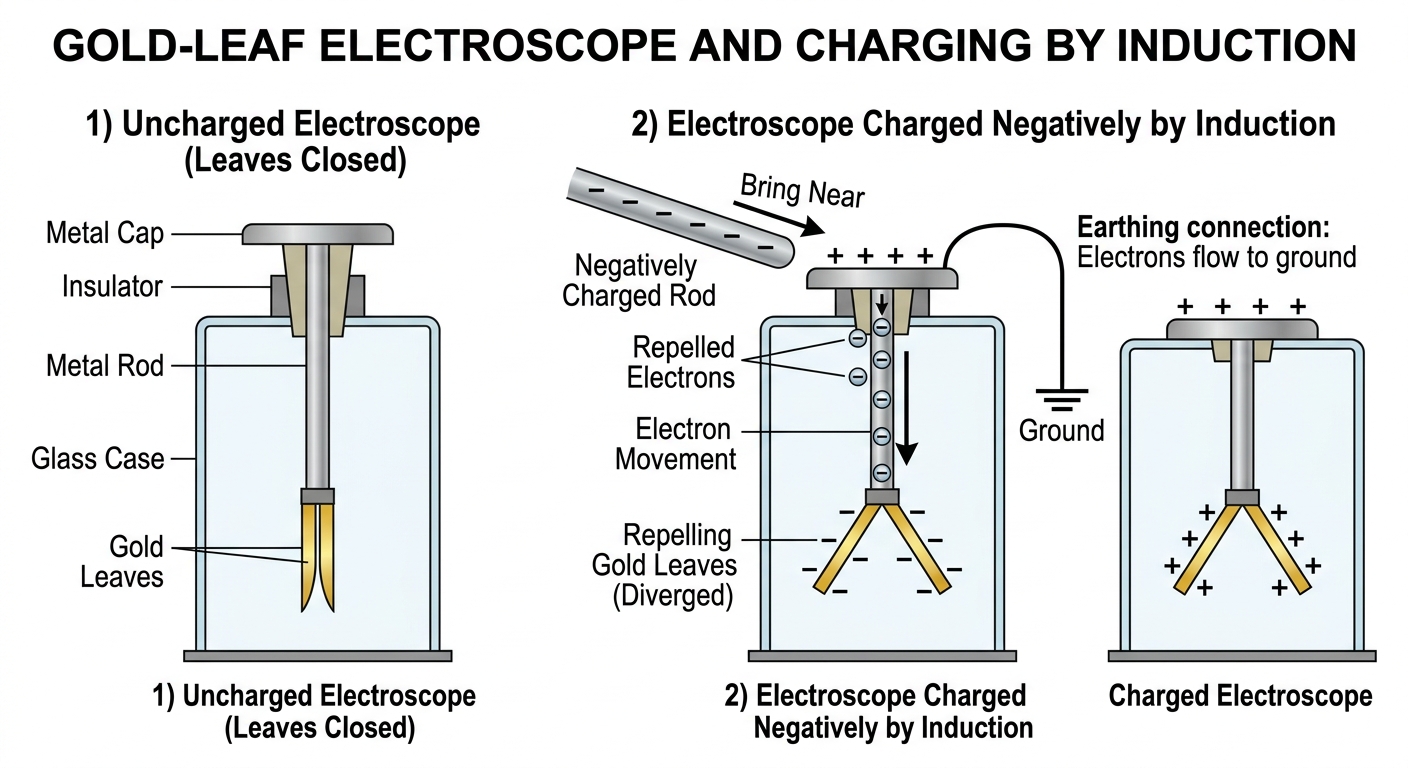
An object can be charged without direct contact with a charged body, a process known as electrostatic induction. This method is particularly useful for charging objects with a charge opposite to that of the inducing body.
How to charge an electroscope by induction:
1. Start with an uncharged electroscope, where the leaves are closed.
2. Bring a charged object (e.g., a negatively charged rod) close to the metal cap of the electroscope, but do not touch it.
3. The free electrons in the electroscope are repelled by the negative rod and move down to the gold leaves, leaving the metal cap positively charged. The gold leaves, now negatively charged, repel each other and diverge.
4. While the charged rod is still in place, touch the metal cap with your finger (earthing). The excess electrons on the leaves are repelled further and flow through your body to the Earth. The leaves collapse slightly as some charge is removed.
5. Remove your finger first, and then remove the charged rod. The electroscope is now left with a net positive charge (opposite to the inducing rod), and the leaves diverge again due to mutual repulsion.
Testing the sign of a charge using a Gold-Leaf Electroscope:
To determine the sign of an unknown charge on an object:
1. First, charge the electroscope by induction or conduction with a known charge (e.g., positively charged). The leaves will diverge.
2. Bring the object with the unknown charge close to the cap of the already charged electroscope.
3. If the leaves diverge further, the unknown charge has the same sign as the electroscope's charge.
4. If the leaves converge (fall closer together), the unknown charge has the opposite sign to the electroscope's charge.
 |
GOLD-LEAF ELECTROSCOPE AND CHARGING BY INDUCTION |
PROPERTIES OF STATIC CHARGES
As established by the Law of Electrostatics:
• Like charges repel each other.
• Unlike charges attract each other.
This fundamental property is crucial for understanding all electrostatic phenomena and applications.
APPLICATIONS OF STATIC ELECTRICITY
Static electricity, despite its apparent simplicity, has numerous practical applications in various technologies.
1. Spray Painting
Electrostatic spray painting ensures an even coating and reduces paint wastage.
* The object to be painted (often a metal car body) is electrically charged, typically positively.
* The paint droplets exiting the spray gun are given an opposite charge, usually negative, by an electrostatic charging unit within the gun.
* Due to the electrostatic attraction between the oppositely charged paint droplets and the object, the paint is uniformly attracted to and adheres to all surfaces of the object, even those not directly facing the spray gun (wraparound effect). This minimises overspray and provides a smooth finish.
2. Photocopier (Xerography)
Photocopiers utilise static charges to create copies of documents.
* The core component is a rotating drum coated with a photoconductive material (e.g., selenium), which is initially given a uniform positive charge.
* A bright light illuminates the original document. Light reflected from the white areas of the document falls onto the charged drum, causing the photoconductive surface in those areas to lose its charge (become conductive when exposed to light).
* The dark areas (text/images) on the document do not reflect light, so the corresponding areas on the drum remain positively charged. This creates a latent electrostatic image on the drum.
* Negatively charged toner (a fine black powder) is then applied to the drum. The toner particles are attracted only to the positively charged areas (the image areas) on the drum.
* A sheet of paper, given a strong positive charge, is pressed against the drum. The toner is transferred from the drum to the paper.
* Finally, the paper passes through heated rollers, which fuse the toner onto the paper, creating a permanent copy.
3. Inkjet Printer
Inkjet printers use static charges to direct tiny ink droplets onto paper to form images and text.
* Tiny ink droplets are ejected from a nozzle.
* These droplets pass through an electrostatic charging unit, which gives them a specific electric charge.
* The charged droplets then pass between a pair of deflecting plates. These plates have varying electric potentials, creating an electric field.
* The electric field deflects the charged ink droplets by different amounts, guiding them to precise locations on the paper to form the desired image. Uncharged droplets are typically directed to a gutter for recycling.
4. Electrostatic Precipitator
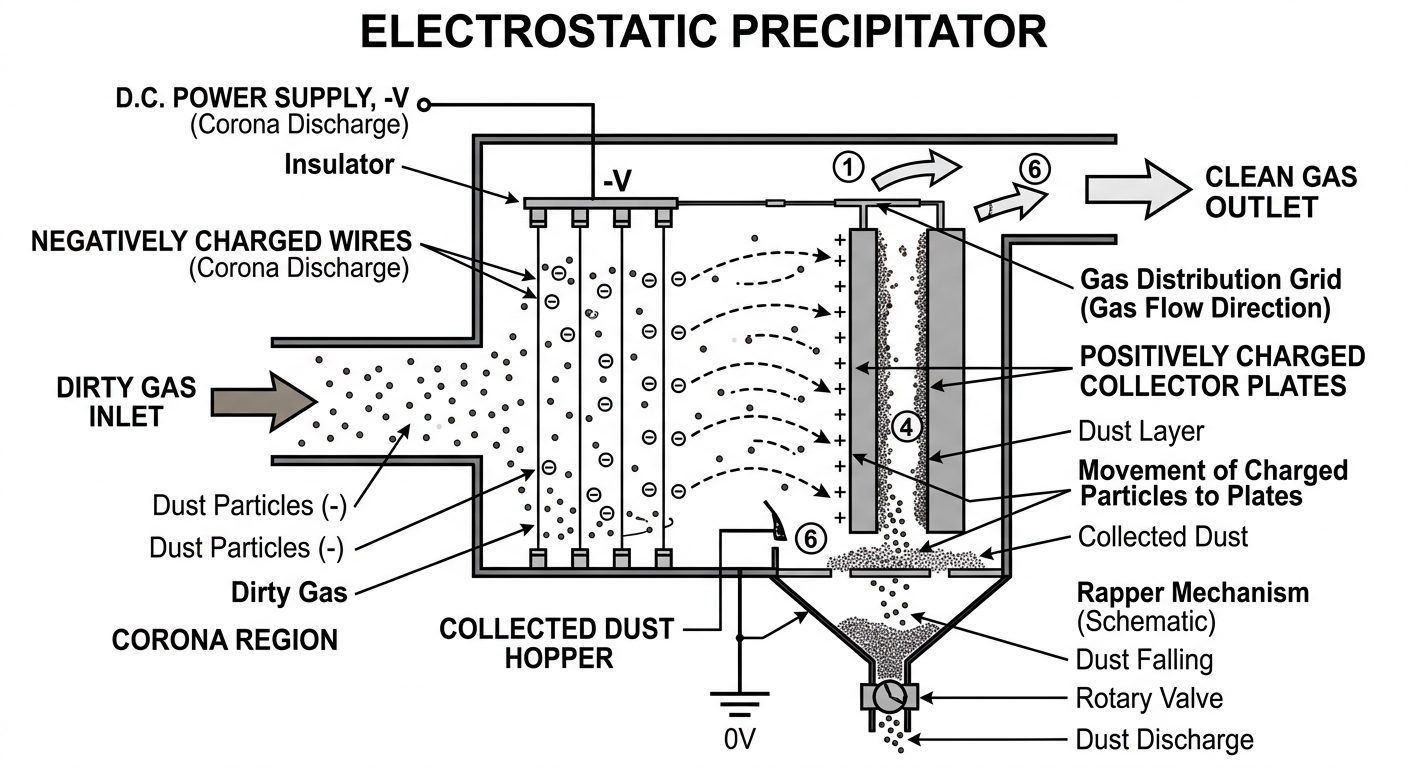
Electrostatic precipitators are essential devices used in industries (e.g., power stations, cement factories) to remove dust, smoke, and other particulate pollutants from exhaust gases before they are released into the atmosphere.
* Exhaust fumes containing particulate matter pass through a region with thin, negatively charged wires (corona wires).
* As the particles pass near these wires, they acquire negative charges.
* Further downstream, there are large, positively charged metal plates.
* The negatively charged dust and smoke particles are strongly attracted to these positively charged collector plates, where they accumulate.
* Periodically, the collector plates are shaken or vibrated, causing the collected dust to fall into hoppers for disposal, thus cleaning the exhaust gases.
 |
ELECTROSTATIC PRECIPITATOR |
RELATIONSHIP BETWEEN CURRENT AND STATIC ELECTRICITY
While both static electricity and current electricity involve electric charges, they differ fundamentally in their nature.
Current Electricity is the continuous flow of electric charges (usually electrons) through a conductor. This flow is driven by a potential difference (voltage) and forms an electric current. Examples include the electricity that powers our homes and appliances.
Static Electricity involves charges that are stationary or accumulate on the surface of an object without continuous flow.
However, despite these differences, static electricity can produce effects that are similar to those of current electricity, especially during rapid discharge:
• Sparks and Shocks: When a statically charged object rapidly discharges its accumulated charges, it can create a visible spark and deliver an electric shock. This phenomenon is similar to the effects observed when an electric current flows, albeit for a very brief duration. For example, touching a doorknob after walking across a carpet can result in a small static shock, which is essentially a miniature, transient electric current.
• Heating Effects: Although less pronounced than with continuous current, a rapid discharge of static electricity can generate localised heat. For instance, a lightning strike, which is a massive static discharge, generates immense heat, causing air to expand rapidly and produce thunder.
• Magnetic Effects: While static charges themselves do not produce a continuous magnetic field, the rapid movement of charges during a static discharge constitutes a transient current, which can produce a momentary magnetic field.
Comparison: Static Electricity vs. Current Electricity
| Feature |
Static Electricity |
Current Electricity |
| Nature of Charges |
Charges are at rest (stationary) on surfaces. |
Charges are in continuous motion (flow). |
| Duration |
Temporary, build-up and rapid discharge. |
Continuous flow as long as circuit is complete. |
| Source |
Friction, induction, contact (e.g., rubbing materials). |
Generators, batteries, solar cells. |
| Effects |
Attraction/repulsion, sparks, shocks during discharge. |
Heating, lighting, magnetic, chemical effects. |
| Measurement |
Measured in Coulombs (charge), detected by electroscope. |
Measured in Amperes (current), Volts (PD), Ohms (resistance). |
Figure: Comparing static and current electricity
EFFECTS OF STATIC CHARGES ON THE ENVIRONMENT
Static electricity can have significant and sometimes hazardous effects on the environment.
1. Lightning
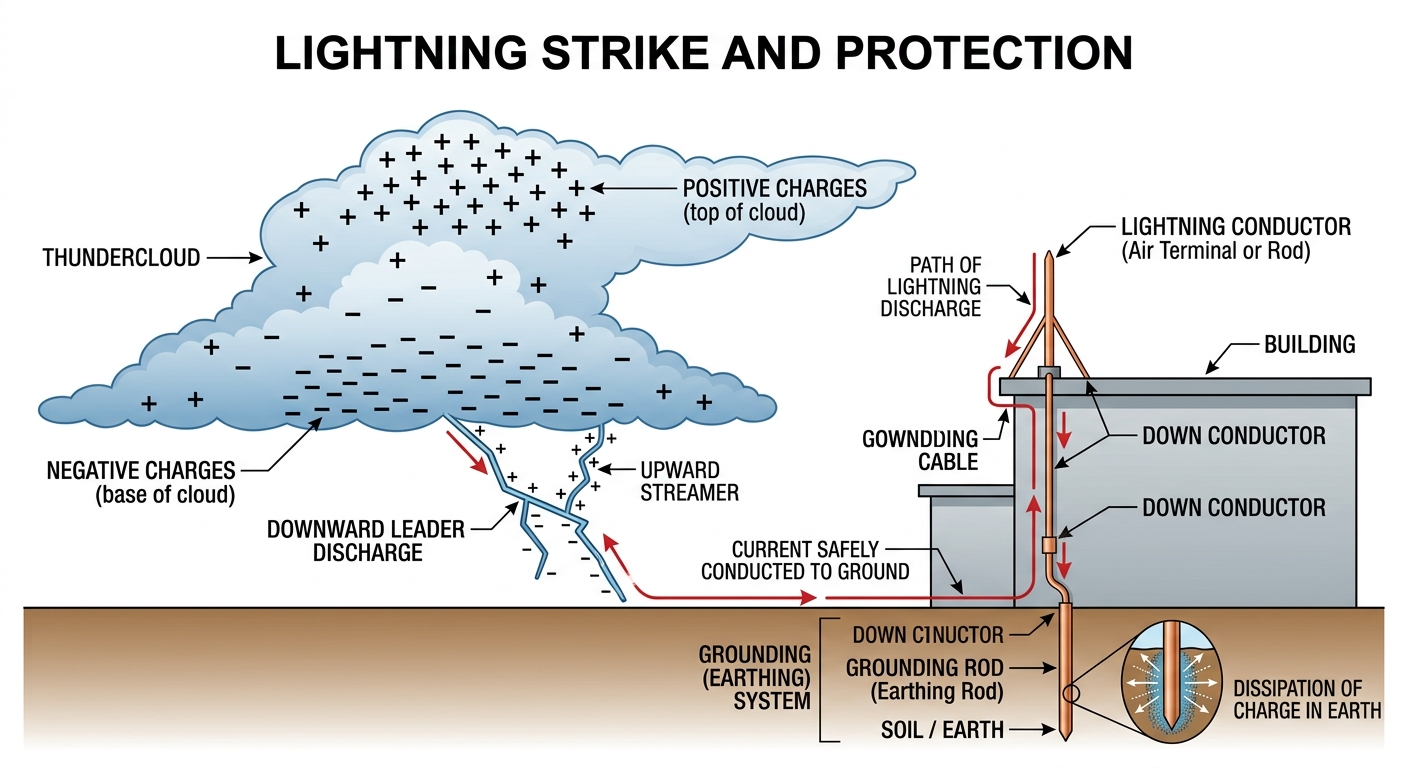
Lightning is the most dramatic and powerful natural manifestation of static electricity. It occurs due to the build-up of massive static charges within storm clouds, or between clouds and the ground.
* Within thunderclouds, water droplets, ice crystals, and hail stones collide violently due to strong updrafts and downdrafts. These collisions cause a separation of charges, with lighter, positively charged particles rising to the top of the cloud and heavier, negatively charged particles accumulating at the base.
* This creates an enormous potential difference between different parts of the cloud or between the cloud and the Earth's surface (which becomes positively charged by induction).
* When the potential difference becomes sufficiently large to overcome the insulating capacity of the air (dielectric breakdown), a massive electrical discharge occurs in the form of a lightning flash. This discharge rapidly neutralises the charge imbalance.
* Lightning is extremely dangerous, capable of causing fires, severe injuries, and fatalities to humans and wildlife. It can also damage buildings and electrical infrastructure.
* Lightning conductors are installed on tall buildings and structures to provide a safe path for lightning current to flow directly to the Earth, thus protecting the building from damage.
2. Fire Hazards
Static electricity can pose a significant fire hazard, especially in environments where flammable materials (liquids, gases, or dust) are present.
* The movement of non-conductive materials, such as flowing flammable liquids (e.g., petrol, solvents) through pipes or during pouring, can generate static charges through friction.
* If a sufficient charge builds up, it can discharge as a spark. In the presence of flammable vapours or dust, this spark can ignite the material, leading to an explosion or fire.
* This is why strict earthing and bonding procedures are required in industries dealing with flammable substances, to dissipate static charges safely.
 |
LIGHTNING STRIKE AND PROTECTION |
SUMMARY
Static electricity involves the accumulation of electric charges on the surface of objects, primarily through electron transfer via friction or induction. These charges, either positive or negative, interact according to the Law of Electrostatics: like charges repel, and unlike charges attract. The gold-leaf electroscope is a key instrument for detecting and identifying the sign of these charges. Static electricity finds practical applications in technologies like spray painting, photocopiers, inkjet printers, and electrostatic precipitators, where controlled electrostatic forces are used. While fundamentally different from current electricity, the rapid discharge of static charges can produce similar effects, such as sparks and shocks. Environmentally, static charges are responsible for the powerful phenomenon of lightning and can pose fire hazards in industrial settings, necessitating safety measures like lightning conductors and earthing.
PRACTICE QUESTIONS
EASY
1. Define static electricity.
2. State the Law of Electrostatics.
3. Name two types of electric charges.
4. What happens to an object that loses electrons?
5. What is the primary function of a gold-leaf electroscope?
MEDIUM
6. Describe how an object becomes positively charged.
7. Explain the difference between charging by friction and charging by contact.
8. A negatively charged rod is brought near the cap of an uncharged gold-leaf electroscope without touching it. Describe what happens to the gold leaves and explain why.
9. List three practical applications of static electricity.
10. Briefly explain how an electrostatic precipitator works to remove dust from exhaust gases.
HARD
11. You have an uncharged gold-leaf electroscope and a positively charged glass rod. Describe, with the aid of diagrams, how you would charge the electroscope negatively using induction.
12. Discuss the main differences between static electricity and current electricity, highlighting at least three distinct points.
13. Explain the formation of lightning in a thundercloud and describe how a lightning conductor helps to protect a building.
14. A student rubs a plastic ruler with a woollen cloth.
(a) Explain why the ruler becomes charged.
(b) If the ruler is then used to pick up small pieces of paper, what type of force is responsible for this attraction?
(c) What safety precautions should be taken when dealing with static electricity in environments with flammable materials?
SOLUTIONS
EASY
1. Static electricity is the build-up of electric charges on the surface of an object that remain at rest.
2. The Law of Electrostatics states that like charges repel each other, and unlike charges attract each other.
3. Positive charges and negative charges.
4. It becomes positively charged.
5. To detect the presence and sign of an electric charge.
MEDIUM
6. An object becomes positively charged when it loses electrons. Electrons, being negatively charged, leave the object, resulting in an excess of positively charged protons, thus giving the object a net positive charge.
7. Charging by friction occurs when two different insulating materials are rubbed together, causing electrons to be transferred from one material to the other. Both materials become charged with opposite signs. Charging by contact (conduction) occurs when a charged object directly touches an uncharged object, allowing charges to flow from the charged object to the uncharged object, giving both objects the same type of charge.
8. When a negatively charged rod is brought near the cap of an uncharged gold-leaf electroscope without touching it, the free electrons in the electroscope are repelled by the negative rod. These electrons move down the metal rod to the gold leaves. As both gold leaves acquire negative charges, they repel each other due to the Law of Electrostatics and therefore diverge (spread apart). The metal cap, having lost electrons, becomes positively charged by induction.
9. Three practical applications of static electricity are: spray painting, photocopiers, and electrostatic precipitators.
10. In an electrostatic precipitator, exhaust fumes containing dust particles pass through a region with thin, negatively charged wires. The dust particles acquire negative charges from these wires. These negatively charged particles are then attracted to large, positively charged metal collector plates, where they accumulate and are removed from the gas flow, allowing clean gas to be released.
HARD
11. To charge an electroscope negatively by induction using a positively charged glass rod:
1. Start with an uncharged electroscope (leaves closed).
2. Bring the positively charged glass rod close to the metal cap of the electroscope, but do not touch it. The free electrons in the electroscope will be attracted towards the positive rod, moving up to the metal cap. This leaves the gold leaves with a net positive charge (due to electron deficiency), causing them to diverge.
3. While the positively charged rod is still held near the cap, touch the metal cap with your finger (earth the electroscope). Electrons from the Earth will be attracted through your body to the electroscope's cap to neutralise the positive charge there, and some will flow to the leaves, causing them to collapse.
4. First, remove your finger from the cap, breaking the earthing connection. The electroscope now has an excess of electrons (a net negative charge).
5. Finally, remove the positively charged rod. The excess electrons redistribute themselves over the entire electroscope, including the gold leaves. Since the leaves are now negatively charged, they will repel each other and diverge, indicating that the electroscope has been charged negatively by induction.
12. The main differences between static electricity and current electricity are:
* Nature of Charges: Static electricity involves charges that are stationary or accumulated on the surface of an object, whereas current electricity involves the continuous flow of electric charges through a conductor.
* Duration: Static electricity is typically a temporary phenomenon involving charge build-up and rapid discharge, while current electricity involves a sustained flow of charges as long as a complete circuit and potential difference are maintained.
* Generation: Static electricity is primarily generated by friction, induction, or contact between insulating materials. Current electricity is generated by devices like batteries (chemical reactions) or generators (electromagnetic induction).
* Effects: While both can produce sparks and shocks during discharge, current electricity is associated with continuous heating, lighting, and magnetic effects, which are not sustained by static charges.
13. Formation of Lightning: Lightning forms within thunderclouds due to the vigorous collision of water droplets, ice crystals, and hail. These collisions cause a separation of charges: lighter, positively charged particles move to the top of the cloud, while heavier, negatively charged particles accumulate at the base. This creates a significant potential difference between the cloud's base and the positively charged ground (induced charge). When this potential difference exceeds the insulating capacity of the air, a massive electrical discharge, or lightning flash, occurs to neutralise the charge imbalance.
Lightning Conductor: A lightning conductor protects a building by providing a low-resistance path for the lightning current to travel safely to the Earth. It consists of a sharp metal rod mounted at the highest point of the building, connected by a thick copper strip to a metal plate buried deep in the ground. When lightning strikes, the huge electrical current is directed through the conductor and harmlessly dissipated into the Earth, preventing the current from passing through the building's structure and causing damage or fire.
14. (a) When a plastic ruler is rubbed with a woollen cloth, electrons are transferred from the woollen cloth to the plastic ruler due to friction. The plastic ruler, having gained electrons, becomes negatively charged, while the woollen cloth, having lost electrons, becomes positively charged.
(b) The force responsible for attracting the small pieces of paper to the charged ruler is the electrostatic force. The charged ruler induces opposite charges on the near side of the neutral paper pieces and like charges on the far side, leading to a net attractive force.
(c) In environments with flammable materials, several safety precautions related to static electricity are crucial:
* Earthing and Bonding: All conductive equipment, storage tanks, and pipes should be properly earthed (grounded) to dissipate any accumulated static charges safely to the Earth, preventing spark formation.
* Humidification: Increasing the humidity in the air can help reduce static build-up, as moisture in the air makes it more conductive, allowing charges to leak away.
* Antistatic Materials: Using antistatic flooring, clothing, and tools can prevent charge accumulation.
* Slow Operations: Flammable liquids should be transferred slowly to minimise friction and static generation.
* Ionisers: In some cases, air ionisers can be used to neutralise charges by providing both positive and negative ions to the environment.
COMMON MISTAKES TO AVOID
• Confusing Static and Current Electricity: Remember that static charges are at rest, while current involves flowing charges.
• Incorrect Charge Transfer: Always remember that it is electrons that transfer, not protons. Loss of electrons makes an object positive, gain makes it negative.
• Misinterpreting Electroscope Behaviour: Understand that leaves diverge due to repulsion by like charges, and converge due to attraction by unlike charges or neutralisation.
• Assuming Contact for Induction: Charging by induction does not involve direct contact between the charged object and the object being charged.
• Ignoring Earthing in Induction: For induction to result in a net charge, an earthing step is crucial to allow charges to flow to or from the Earth.
• Incorrectly Stating Law of Electrostatics: Be precise: "like repel, unlike attract."
EXAM TIPS
• Diagrams are Key: Be prepared to draw and label diagrams for the gold-leaf electroscope (uncharged, charged by contact, charged by induction) and applications like the electrostatic precipitator. Ensure all labels are clear and accurate.
• Define Terms Accurately: Provide precise definitions for terms like static electricity, charging by friction, charging by induction, and electromotive force.
• Explain Processes Systematically: When asked to explain how an application works or how to charge an electroscope, describe the steps logically and sequentially.
• Understand Charge Movement: Always specify the movement of electrons when explaining charging processes.
• Relate to Real-World Examples: Be ready to provide examples of static electricity in everyday life (e.g., clothes clinging, hair standing on end) and its environmental effects (lightning).
• Distinguish Clearly: Practice distinguishing between static and current electricity, and between different methods of charging (friction, conduction, induction).
QUICK REVISION SUMMARY
• Static Electricity: Build-up of stationary electric charges on an object's surface.
• Charging:
* Friction: Rubbing materials together transfers electrons; one becomes positive (loses e-), one becomes negative (gains e-).
* Contact (Conduction): Charged object touches uncharged object; charges transfer, objects acquire same sign of charge.
* Induction: Charged object brought near uncharged object without touching; charges separate; earthing creates opposite net charge.
• Law of Electrostatics: Like charges repel, unlike charges attract.
• Gold-Leaf Electroscope: Detects charge presence and sign.
• Applications: Spray painting (charged paint attracted to oppositely charged object), photocopiers (charged drum attracts toner), inkjet printers (deflecting charged ink droplets), electrostatic precipitators (charged dust attracted to collector plates).
• Static vs. Current: Static is stationary charge build-up; current is continuous charge flow. Static discharge can mimic current effects (sparks, shocks).
• Environmental Effects:
* Lightning: Massive static discharge between clouds or cloud and ground, caused by charge separation in thunderclouds.
* Fire Hazards: Sparks from static discharge can ignite flammable materials.
• Safety: Lightning conductors provide a safe path to ground; earthing prevents static build-up in industries.