TOPIC: INTRODUCTION TO PHYSICS
SUBTOPIC: Fundamental Concepts of Physics
SPECIFIC COMPETENCES
1. Demonstrate curiosity and inquiry when exploring fundamental concepts of physics.
INTRODUCTION
Physics is a fascinating field that helps us understand how the world around us works, from the smallest particles to the vastness of the universe. It is the foundation of many technologies we use daily, like mobile phones, cars, and electricity. In this unit, we will explore what physics is, its main areas of study, and the systematic way scientists use to learn about the physical world.
CORE CONCEPTS
WHAT IS PHYSICS AND ITS FUNDAMENTAL CONCEPTS
Physics is the branch of science that deals with the study of matter, energy, and their interaction. It seeks to explain natural phenomena and predict how things will behave under different conditions.
A physical quantity is any characteristic of matter or energy that can be measured. Examples include length, mass, time, temperature, and speed.
Every physical quantity is expressed by a magnitude and a suitable unit.
• Magnitude refers to the size or amount of a physical quantity. For example, in "5 meters," 5 is the magnitude.
• A unit is a standard measure used to express the magnitude of a physical quantity. For example, in "5 meters," meters (m) is the unit.
Physics explores fundamental concepts that underpin all physical phenomena. These include:
• Motion: How objects move, their speed, velocity, and acceleration.
• Forces: Pushes or pulls that can change an object's motion or shape.
• Energy: The ability to do work, existing in various forms like kinetic, potential, heat, and electrical energy.
• Momentum: A measure of the mass and velocity of an object, indicating its "quantity of motion."
• Work and Efficiency: Work is done when a force causes displacement, and efficiency measures how much useful energy is produced compared to the total energy input.
• Waves and Vibrations: How energy is transferred through oscillations, such as sound waves, light waves, and seismic waves.
• Electricity and Magnetism: The study of electric charges, currents, magnetic fields, and their interrelationship, which forms the basis of electrical power and electronics.
✅ Check Your Understanding
Pause here. Let learners attempt these before moving on.
| 1. Quick Recall [1 mark] |
Define the term 'Physics'. |
| 2. Apply the Concept [2 marks] |
Give an example of a physical quantity, stating both its magnitude and unit. |
| 3. Misconception Check |
True or False: "A measurement like '20' without any unit is a complete physical quantity." Justify your answer. |
Answers
1. Physics is the branch of science that studies matter, energy, and their interaction.
2. Example: Length = 10 meters. Magnitude is 10, unit is meters (m). (Other examples like mass = 5 kg, time = 2 s are also correct).
3. False. A physical quantity requires both a magnitude (the number) and a unit to be complete and meaningful. Without a unit, '20' does not tell us what is being measured (e.g., 20 kilograms, 20 seconds, 20 meters).
CLASSIFYING BRANCHES OF PHYSICS
Physics is a vast subject, often divided into several branches for easier study. Each branch focuses on specific types of phenomena and principles. Some of the main branches include:
• Mechanics: This is the oldest and most fundamental branch, dealing with the motion of objects and the forces that cause them. It includes the study of statics (objects at rest) and dynamics (objects in motion).
Examples*: How a car moves, how a ball is thrown, the forces acting on a bridge.
• Thermodynamics: This branch deals with heat and its relation to other forms of energy and work. It studies how heat is transferred and how it affects matter.
Examples*: How an engine works, the operation of a refrigerator, how temperature changes affect materials.
• Electricity and Magnetism: This branch studies electric charges, electric currents, magnetic fields, and their relationship. It forms the basis for all electrical and electronic devices.
Examples*: How a light bulb lights up, how electric motors work, the principles behind generators.
• Waves and Optics: This branch focuses on the properties and behaviour of waves, including sound waves, light waves, and other electromagnetic waves. Optics specifically deals with light and its interaction with matter.
Examples*: How sound travels, how a camera lens focuses light, the colours of a rainbow.
• Atomic Physics: This branch studies the structure of the atom, its energy states, and its interactions with other particles and fields.
Examples*: How lasers work, the properties of different elements.
• Nuclear Physics: A sub-field that deals with the nucleus of atoms, including radioactivity, nuclear reactions (fission and fusion), and nuclear energy.
Examples*: Nuclear power generation, medical imaging techniques using radioactive isotopes.
• Electronics: This branch deals with the flow and control of electrons in circuits, especially in semiconductor devices. It is crucial for modern technology.
Examples*: How computers, mobile phones, and radios function.
• Geophysics: This is an interdisciplinary branch that applies the principles of physics to study the Earth and its atmosphere, oceans, and interior.
Examples*: Studying earthquakes, volcanic activity, and climate change.
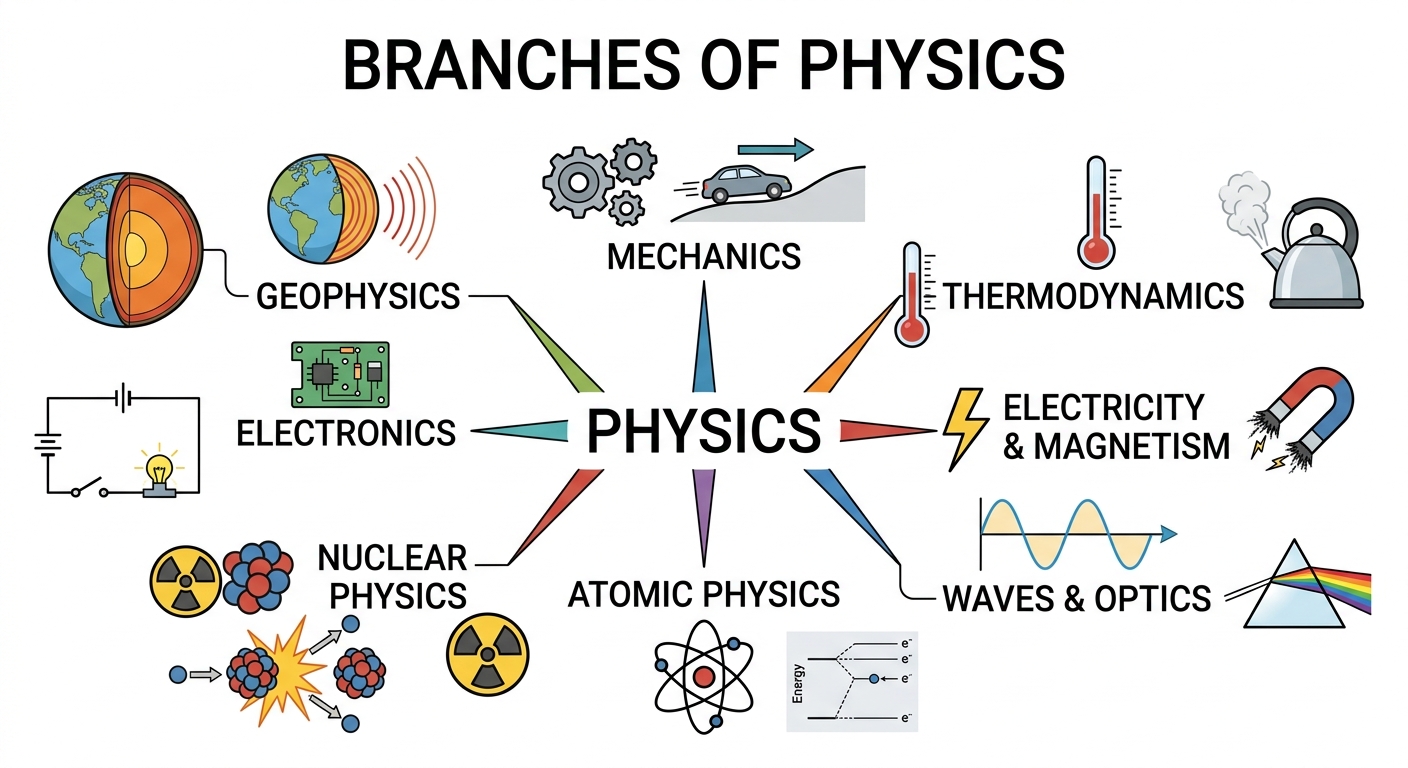 |
BRANCHES OF PHYSICS |
✅ Check Your Understanding
Pause here. Let learners attempt these before moving on.
| 1. Quick Recall [1 mark] |
Name any three branches of Physics. |
| 2. Apply the Concept [2 marks] |
Which branch of physics would be most relevant to understanding how an earthquake occurs? |
| 3. Misconception Check |
True or False: "The study of how a light bulb produces light falls under the branch of Mechanics." Justify your answer. |
Answers
1. Mechanics, Thermodynamics, Electricity and Magnetism, Waves and Optics, Atomic Physics, Nuclear Physics, Electronics, Geophysics (any three).
2. Geophysics, as it applies physics principles to study the Earth.
3. False. The study of how a light bulb produces light involves electric currents and the emission of light, which falls under Electricity and Magnetism and Waves and Optics, respectively, not Mechanics. Mechanics deals with motion and forces.
EXPLORING THE SCIENTIFIC METHODS OF LEARNING PHYSICS
Physics, like all sciences, relies on a systematic approach to gain knowledge and understand the natural world. This approach is known as the scientific method. It involves a series of steps that guide scientists from asking questions to forming conclusions.
The key steps of the scientific method include:
1. Observation: This is the first step, where a scientist notices a phenomenon or asks a question about how something works. Observations can be made directly using our senses or indirectly using instruments.
Example*: Noticing that a dropped object always falls towards the ground.
2. Formulating a Hypothesis: Based on observations, a scientist proposes a possible explanation or an educated guess. A hypothesis must be testable through experimentation.
Example*: Hypothesising that the speed at which an object falls depends on its mass.
3. Experimentation: Designing and carrying out controlled experiments to test the hypothesis. Experiments involve manipulating variables and collecting data. It is crucial to have a control group for comparison.
Example*: Dropping objects of different masses from the same height and measuring their fall time.
4. Data Analysis: Organising, processing, and interpreting the data collected during the experiment. This often involves using mathematical calculations, graphs, and statistical methods to identify patterns or relationships.
Example*: Plotting a graph of mass versus fall time to see if there's a correlation.
5. Interpretation and Conclusion: Based on the data analysis, the scientist determines whether the hypothesis is supported or refuted. A conclusion is drawn, explaining the findings and their implications. If the hypothesis is not supported, it may be revised, and new experiments may be designed.
Example*: Concluding that, in a vacuum, objects of different masses fall at the same rate, thus refuting the initial hypothesis.
6. Scientific Reporting and Presentation: Sharing the findings with the scientific community and the public through reports, scientific papers, and presentations. This allows others to review, replicate, and build upon the research. Transparency and clear communication are vital.
Example*: Publishing the results in a scientific journal or presenting them at a conference.
This iterative process helps refine our understanding of physics, leading to the development of theories and laws that describe the universe.
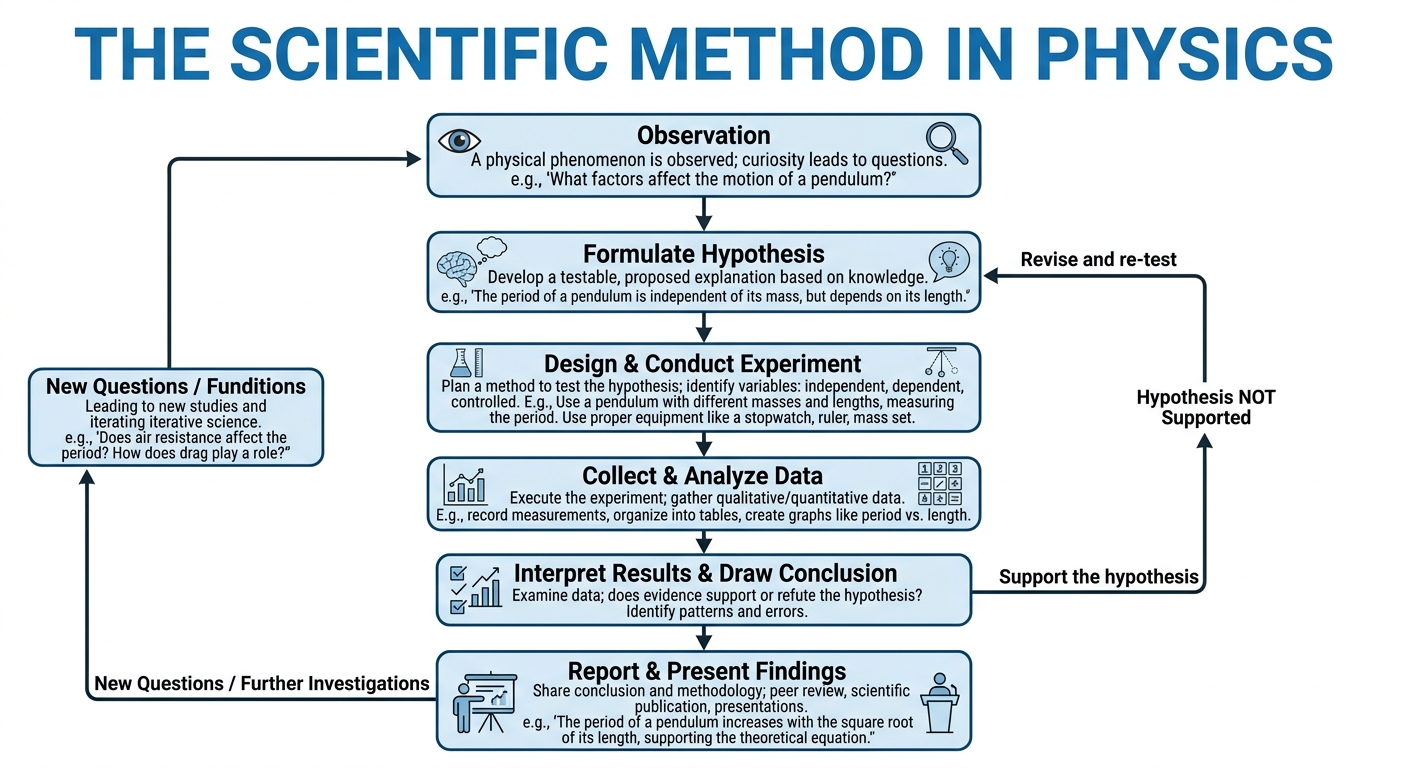 |
THE SCIENTIFIC METHOD IN PHYSICS |
✅ Check Your Understanding
Pause here. Let learners attempt these before moving on.
| 1. Quick Recall [1 mark] |
What is the initial step in the scientific method? |
| 2. Apply the Concept [2 marks] |
A student notices that a metal spoon gets hot when left in a cup of tea. Formulate a simple hypothesis for this observation. |
| 3. Misconception Check |
True or False: "Once an experiment supports a hypothesis, it is considered a proven, unchangeable scientific law." Justify your answer. |
Answers
1. Observation.
2. Hypothesis: "The heat from the tea is transferred to the metal spoon through conduction." (Other reasonable hypotheses related to heat transfer are also acceptable).
3. False. A hypothesis, even when supported by experiments, is never considered absolutely proven or unchangeable. Scientific knowledge is always open to revision with new evidence or more refined experiments. It can become a theory or law after extensive testing and validation, but even then, it remains subject to further scrutiny.
SUMMARY
Physics is the study of matter, energy, and their interactions, forming the basis of our understanding of the natural world. Physical quantities, characterized by magnitude and unit, are central to physics. The field is broadly categorized into branches such as Mechanics, Thermodynamics, Electricity and Magnetism, Waves and Optics, Atomic Physics, Nuclear Physics, Electronics, and Geophysics. All scientific inquiry in physics follows a systematic approach called the scientific method, which involves observation, hypothesis formation, experimentation, data analysis, interpretation, and reporting.
ASSESSMENT QUESTIONS
1. Define the following terms:
a) Physics \[1 mark]
b) Physical quantity \[1 mark]
c) Magnitude \[1 mark]
d) Unit \[1 mark]
2. State four fundamental concepts explored in Physics. \[4 marks]
3. Match the following phenomena to the most appropriate branch of physics: \[4 marks]
i. The movement of a bicycle
ii. How a refrigerator cools food
iii. The working of a radio
iv. Studying the Earth's magnetic field
A. Thermodynamics
B. Mechanics
C. Electricity and Magnetism
D. Geophysics
4. List the six main steps of the scientific method in their correct order. \[6 marks]
5. Explain why it is important for scientists to report and present their findings. \[2 marks]
6. Distinguish between a 'hypothesis' and a 'conclusion' in the scientific method. \[2 marks]
COMMON DIFFICULTIES & MISCONCEPTIONS
• Confusing Magnitude and Unit: Learners often struggle to differentiate between the numerical value (magnitude) and the standard of measurement (unit) for a physical quantity. Emphasize that both are essential.
• Physics is only about calculations: Students might think physics is just about complex maths. Highlight that it's fundamentally about understanding why and how things happen, with mathematics being a tool for precise description.
• Scientific Method as a Linear Process: Misconception that the scientific method is a rigid, one-way path. Stress that it is iterative, with feedback loops, especially when hypotheses are not supported.
• Hypothesis vs. Theory vs. Law: Students often confuse these terms, thinking a hypothesis becomes a theory, which then becomes a law. Explain that they are distinct concepts with different levels of evidence and scope. A hypothesis is a testable explanation, a theory is a well-substantiated explanation, and a law is a description of observed phenomena.
• Branches of Physics are mutually exclusive: Learners might think that a phenomenon can only belong to one branch. Explain that many real-world situations involve principles from multiple branches (e.g., a car engine involves mechanics and thermodynamics).
QUICK REFERENCE SUMMARY
• Physics: Study of matter, energy, and their interactions.
• Physical Quantity: Measurable characteristic (e.g., length, mass).
• Magnitude: Size/amount.
• Unit: Standard measure.
• Key Concepts: Motion, Forces, Energy, Momentum, Work, Waves, Electricity, Magnetism.
• Branches: Mechanics (motion, forces), Thermodynamics (heat, energy), Electricity & Magnetism (charges, fields), Waves & Optics (light, sound), Atomic Physics (atom structure), Nuclear Physics (nucleus), Electronics (electron flow), Geophysics (Earth physics).
• Scientific Method Steps: Observation → Hypothesis → Experimentation → Data Analysis → Interpretation & Conclusion → Reporting & Presentation.