TOPIC: INTRODUCTION TO PHYSICS
SUBTOPIC: Fundamental Concepts of Physics
SPECIFIC COMPETENCES:
1. Demonstrate curiosity and inquiry when exploring fundamental concepts of physics.
INTRODUCTION
Physics is a fascinating branch of science that helps us understand the world around us, from the smallest particles to the vastness of the universe. It is the foundation for many technological advancements that shape our daily lives, such as electricity, communication, and transportation. This unit will introduce you to what physics is, its core ideas, different areas of study within physics, and how physicists approach problems using a systematic method. By exploring these fundamental concepts, you will begin to appreciate the power of physics in explaining natural phenomena and inspiring innovation.
CORE CONCEPTS
1. WHAT IS PHYSICS?
Physics is the natural science that studies matter, its fundamental constituents, its motion and behaviour through space and time, and the related entities of energy and force. Simply put, physics is the study of how things around us work. For example, it explains how a car moves, why a ball falls to the ground, how electricity lights a bulb, or how sound travels.
In physics, we often deal with physical quantities. A physical quantity is any property of matter or energy that can be measured. For a physical quantity to be fully understood, it must have two parts:
• Magnitude: This is the size or numerical value of the quantity. For instance, in "5 kilograms," the "5" is the magnitude.
• Unit: This is the standard measure used to express the quantity. In "5 kilograms," "kilograms" (kg) is the unit.
For example, when we say the length of a table is 1.5 metres, "1.5" is the magnitude and "metres" is the unit. Without both, the measurement is incomplete.
Physics also explores several fundamental concepts that are essential to understanding how the universe operates. These include:
• Motion: The change in position of an object over time.
• Forces: Pushes or pulls that can change an object's motion or shape.
• Energy: The ability to do work or cause change. It exists in various forms, such as kinetic, potential, heat, light, and electrical energy.
• Momentum: A measure of the mass and velocity of an object, indicating its "quantity of motion."
• Work and Efficiency: Work is done when a force causes displacement. Efficiency relates to how much useful energy is produced compared to the total energy input.
• Waves and Vibrations: Phenomena involving the transfer of energy through oscillations, such as sound waves, light waves, and vibrations in solids.
• Electricity and Magnetism: The study of electric charges, currents, fields, and their relationship with magnetic fields, forming the basis of many modern technologies.
✅ Check Your Understanding
Pause here. Let learners attempt these before moving on.
| 1. Quick Recall [1 mark] |
Define physics in your own words. |
| 2. Apply the Concept [2 marks] |
Identify the magnitude and unit in the statement: "The mass of a bag of maize is 25 kg." |
| 3. Misconception Check |
True or False: Physics only studies very large objects like planets and galaxies, not everyday items. Justify your answer. |
Answers
1. Physics is the study of matter, energy, and their interaction, explaining how things work in the natural world.
2. Magnitude = 25, Unit = kg.
3. False. Physics studies phenomena across all scales, from subatomic particles and everyday objects (like a ball falling) to cosmic structures (like planets and galaxies). The misconception is that physics is limited to only one scale.
2. CLASSIFYING BRANCHES OF PHYSICS
Physics is a vast field, so it is often divided into several branches, each focusing on specific types of phenomena or scales. Understanding these branches helps to classify different areas of study within physics.
• Mechanics: This branch deals with motion, forces, and energy. It includes the study of how objects move, why they move, and the effects of forces on them. Examples include the motion of cars, projectiles, and the operation of simple machines.
• Thermodynamics: This branch focuses on heat, temperature, and their relation to energy and work. It explains how heat transfers, how engines work, and the properties of matter at different temperatures.
• Electricity and Magnetism: This branch studies electric charges, electric currents, magnetic fields, and the relationship between them. It is fundamental to understanding electronics, motors, generators, and electromagnetic waves like light and radio waves.
• Atomic Physics: This branch explores the structure of atoms, their energy states, and their interactions with light and other particles. It delves into the behaviour of electrons around the nucleus.
• Electronics: This is a sub-branch that deals with the control of electron flow, especially in semiconductor devices like transistors and integrated circuits. It's crucial for computers, mobile phones, and all modern electronic gadgets.
• Geophysics: This branch applies the principles of physics to study the Earth. It includes understanding earthquakes, volcanoes, Earth's magnetic field, and the structure of the Earth's interior.
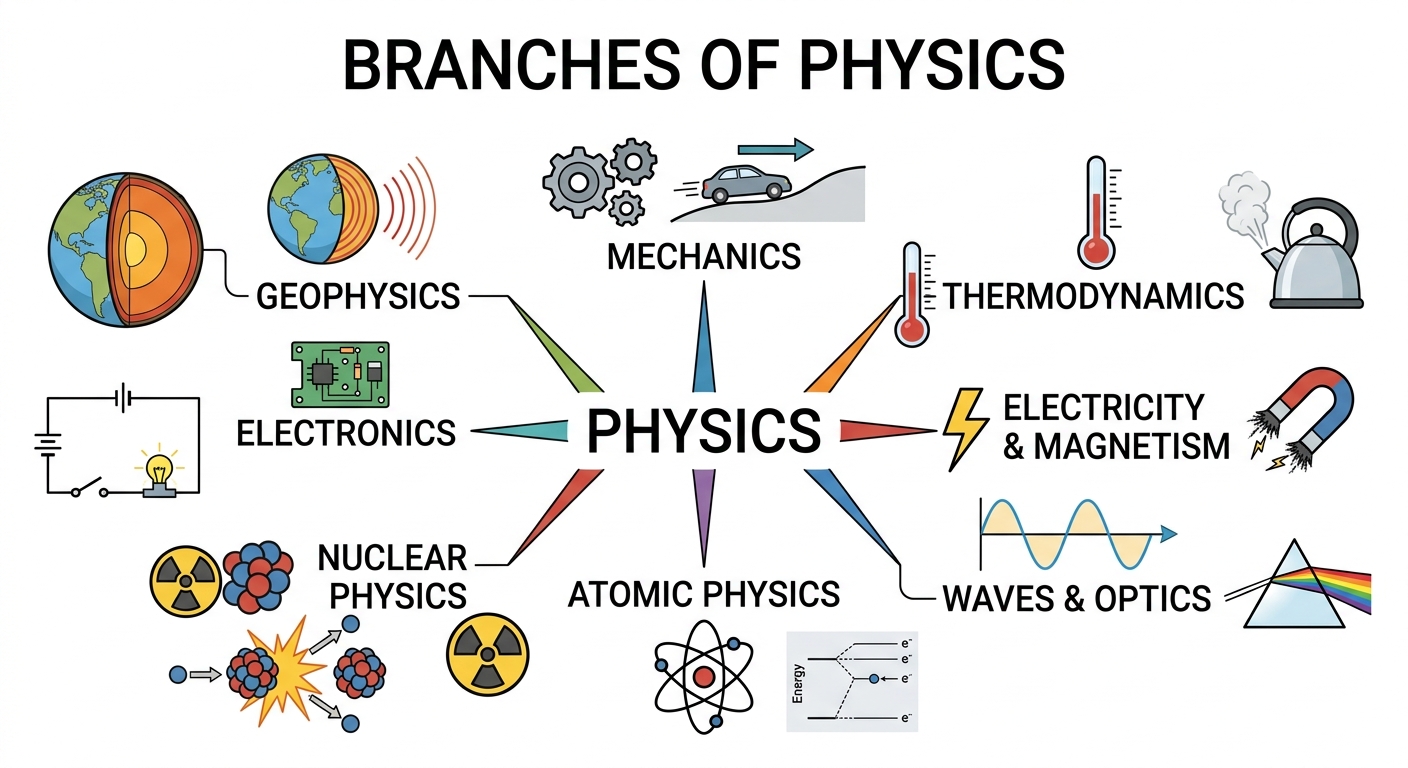 |
BRANCHES OF PHYSICS |
✅ Check Your Understanding
Pause here. Let learners attempt these before moving on.
| 1. Quick Recall [1 mark] |
Which branch of physics would you use to study how a car engine converts fuel into motion? |
| 2. Apply the Concept [2 marks] |
A scientist is studying the movement of tectonic plates causing earthquakes. Which two branches of physics are most relevant to this study? |
| 3. Misconception Check |
True or False: Electronics is a completely separate field from physics and does not rely on physics principles. Justify your answer. |
Answers
1. Mechanics and Thermodynamics.
2. Mechanics (for plate movement and forces) and Geophysics (for Earth's study, including earthquakes).
3. False. Electronics is a sub-branch of physics (or an applied field heavily reliant on physics) because it deals with the control of electron flow, which is governed by principles of electricity and magnetism, a core branch of physics. The misconception is that applied fields operate independently of their foundational sciences.
3. EXPLORING THE SCIENTIFIC METHOD IN PHYSICS
Physics is an experimental science. Physicists use a systematic approach called the scientific method to investigate natural phenomena, formulate explanations, and test their ideas. This method ensures that findings are reliable and can be reproduced by others. The key steps of the scientific method include:
1. Observation: This involves carefully watching and recording phenomena or events. It often leads to questions about "how" or "why" something happens. For example, observing that objects fall to the ground.
2. Formulating a Hypothesis: Based on observations, a testable explanation or prediction is proposed. A hypothesis is an educated guess. For example, hypothesising that heavier objects fall faster than lighter objects.
3. Experimentation: Designing and conducting controlled experiments to test the hypothesis. This involves manipulating variables and collecting data. For our example, dropping objects of different masses from the same height and measuring their fall times.
4. Data Analysis: Organising, processing, and interpreting the collected data. This may involve calculations, graphing, and looking for patterns or relationships. Analysing the recorded fall times to see if mass affects the speed of falling.
5. Interpretation and Conclusion: Drawing conclusions based on the data analysis. The hypothesis is either supported or rejected. If the hypothesis is rejected, it may lead to a new hypothesis and further experiments. In our example, experiments would show that objects of different masses fall at the same rate in a vacuum, leading to the conclusion that mass does not affect fall time (neglecting air resistance).
6. Scientific Reporting and Presentation: Communicating the findings, methods, and conclusions to the scientific community and the public. This allows others to review, replicate, and build upon the research.
The scientific method is often an iterative process, meaning that conclusions from one experiment might lead to new observations and further hypotheses, forming a continuous cycle of inquiry and discovery.
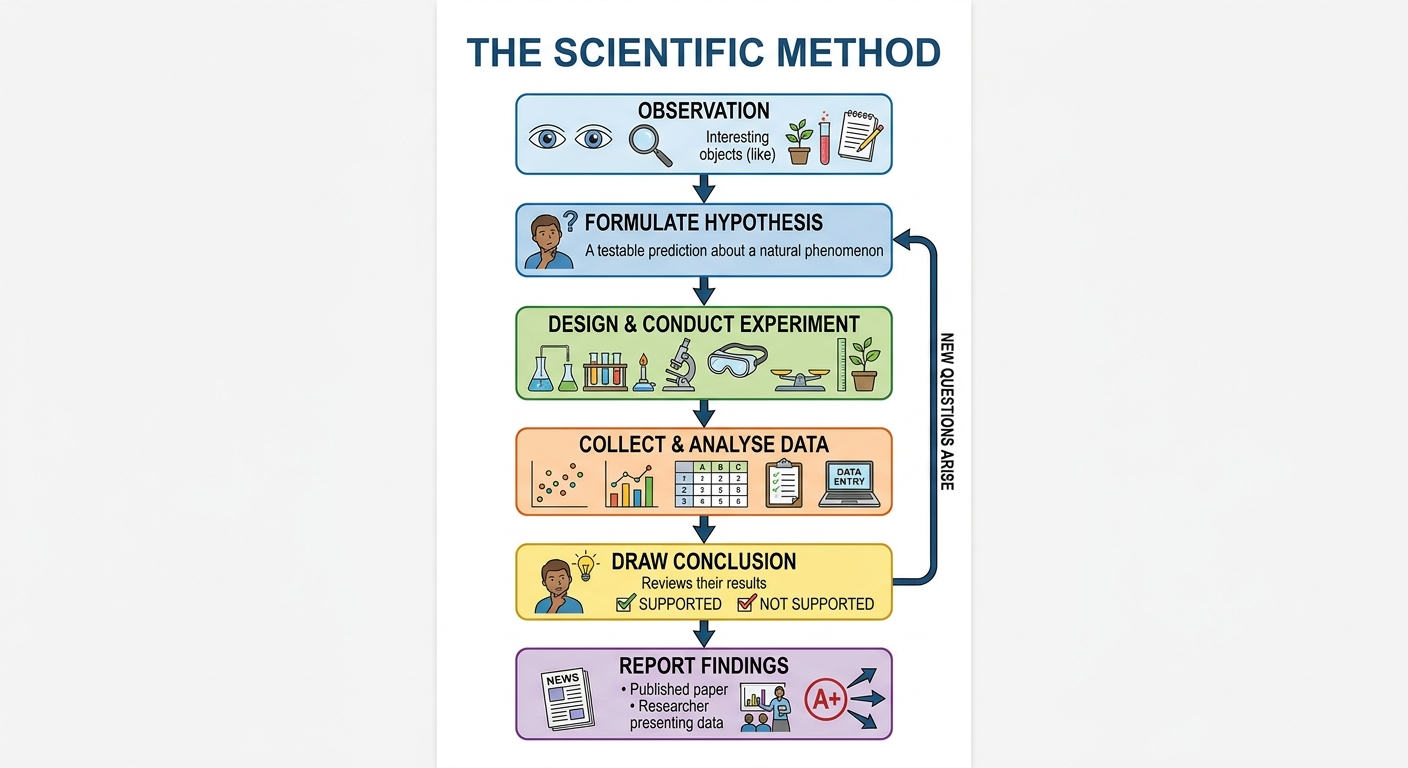 |
THE SCIENTIFIC METHOD |
✅ Check Your Understanding
Pause here. Let learners attempt these before moving on.
| 1. Quick Recall [1 mark] |
What is the first step in the scientific method? |
| 2. Apply the Concept [3 marks] |
A student observes that a lamp is not working. He thinks the bulb might be faulty. Describe the next two steps he would take following the scientific method to test his idea. |
| 3. Misconception Check |
True or False: Once an experiment confirms a hypothesis, it becomes an undeniable scientific law that can never be challenged. Justify your answer. |
Answers
1. Observation.
2. First, he would formulate a hypothesis: "The lamp is not working because the bulb is faulty." (1 mark). Second, he would conduct an experiment: "Replace the bulb with a known working bulb." (1 mark). Third, he would observe if the lamp now works (data collection) and draw a conclusion (1 mark).
3. False. Scientific findings, even well-established laws, are always open to refinement or re-evaluation if new evidence emerges or more precise measurements are made. Science is self-correcting and progressive, not absolute. The misconception is that scientific laws are immutable.
SUMMARY
In this unit, we have learned that physics is the study of matter, energy, and their interactions, providing explanations for how the world works. We explored fundamental concepts such as motion, forces, energy, momentum, work and efficiency, waves and vibrations, and electricity and magnetism. We also classified physics into key branches like Mechanics, Thermodynamics, Electricity and Magnetism, Atomic Physics, Electronics, and Geophysics. Finally, we understood the systematic process of the scientific method, which involves observation, hypothesis, experimentation, data analysis, interpretation, and communication, as the cornerstone of scientific inquiry in physics.
ASSESSMENT QUESTIONS
1. [1 mark] What is the primary focus of study in physics?
A. Living organisms
B. Matter, energy, and their interaction
C. Chemical reactions
D. Historical events
2. [1 mark] Which of the following is NOT a fundamental concept explored in physics?
A. Motion
B. Emotions
C. Energy
D. Forces
3. [2 marks] Distinguish between "magnitude" and "unit" when describing a physical quantity. Provide an example.
4. [1 mark] A physicist is studying how heat from the sun reaches the Earth. Which branch of physics is most relevant to this study?
A. Mechanics
B. Atomic Physics
C. Thermodynamics
D. Electronics
5. [1 mark] The study of how a mobile phone operates, including its internal components and signals, primarily falls under which branch of physics?
A. Geophysics
B. Mechanics
C. Electronics
D. Thermodynamics
6. [3 marks] Describe the first three steps of the scientific method in the correct order.
7. [2 marks] A student observes that a heavy book and a light piece of paper fall at different rates when dropped simultaneously from the same height. Formulate a simple hypothesis to explain this observation.
8. [2 marks] Explain why the scientific method is considered an "iterative" process.
9. [1 mark] Which of the following is the final step in the scientific method?
A. Formulating a hypothesis
B. Experimentation
C. Data analysis
D. Scientific reporting and presentation
10. [2 marks] Name two fundamental concepts of physics that are crucial for understanding how a hydro-electric power station generates electricity.
COMMON DIFFICULTIES & MISCONCEPTIONS
1. Confusing Physics with other Sciences: Learners often struggle to differentiate physics from chemistry or biology.
* Clarification: Emphasise that physics focuses on the fundamental laws of nature, matter, energy, and forces, rather than specific compositions (chemistry) or living systems (biology). All other sciences rely on physics principles.
2. Misunderstanding "Physical Quantity": Some learners might think any quantity is a physical quantity.
* Clarification: Stress that a physical quantity MUST be measurable and expressed with both a magnitude and a unit. "Happiness" is a quantity but not a physical one in physics.
3. Linear View of the Scientific Method: Learners may see the scientific method as a rigid, one-way sequence of steps.
* Clarification: Highlight that it's often a cyclical or iterative process, where conclusions can lead back to new observations or revised hypotheses. Experiments don't always "prove" a hypothesis; they either support or refute it.
4. Misconception about "Hypothesis" and "Theory": These terms are often used interchangeably or incorrectly.
* Clarification: A hypothesis is a testable prediction, while a theory is a well-substantiated explanation acquired through the scientific method and repeatedly tested and confirmed through observation and experimentation.
5. Ignoring Units: Learners may perform calculations without paying attention to the units.
* Clarification: Reinforce that units are as important as the numerical magnitude in physics. An answer without the correct unit is incomplete.
QUICK REFERENCE SUMMARY
Key Terms & Concepts: Introduction to Physics
| Physics |
Study of matter, energy, and their interaction. |
| Physical Quantity |
A measurable property, expressed by a magnitude and a unit. |
| Magnitude |
The size or numerical value of a physical quantity. |
| Unit |
The standard measure of a physical quantity. |
| Scientific Method |
Systematic approach to investigate phenomena (Observation, Hypothesis, Experiment, Data Analysis, Conclusion, Communication). |
Figure: Key terms and definitions from the unit