TOPIC: INTRODUCTION TO PHYSICS
SUBTOPIC: APPLICATION OF PHYSICS
SPECIFIC COMPETENCES:
1. Relate the concepts of physics to everyday life.
INTRODUCTION
Physics is a fascinating science that helps us understand how the world around us works. From the smallest particles to the largest galaxies, physics explains the fundamental principles governing matter, energy, and their interactions. This unit will explore how these principles are applied in various aspects of our daily lives, influencing fields such as engineering, medicine, and agriculture, and even simple actions like measuring mass or charging a phone.
CORE CONCEPTS: APPLICATIONS OF PHYSICS IN EVERYDAY LIFE
Physics is the study of matter, energy, and their interaction. It seeks to explain natural phenomena and provides the foundation for much of modern technology and innovation. To understand physics, we often deal with physical quantities, which are quantities that can be measured. Each physical quantity is expressed by a magnitude (the size of the quantity, e.g., 5, 100) and a suitable unit (the standard measure of a quantity, e.g., metres, kilograms).
Understanding physics allows us to develop new technologies, solve complex problems, and improve our quality of life. Let's explore some key areas where physics is critically applied.
1. Physics in Engineering
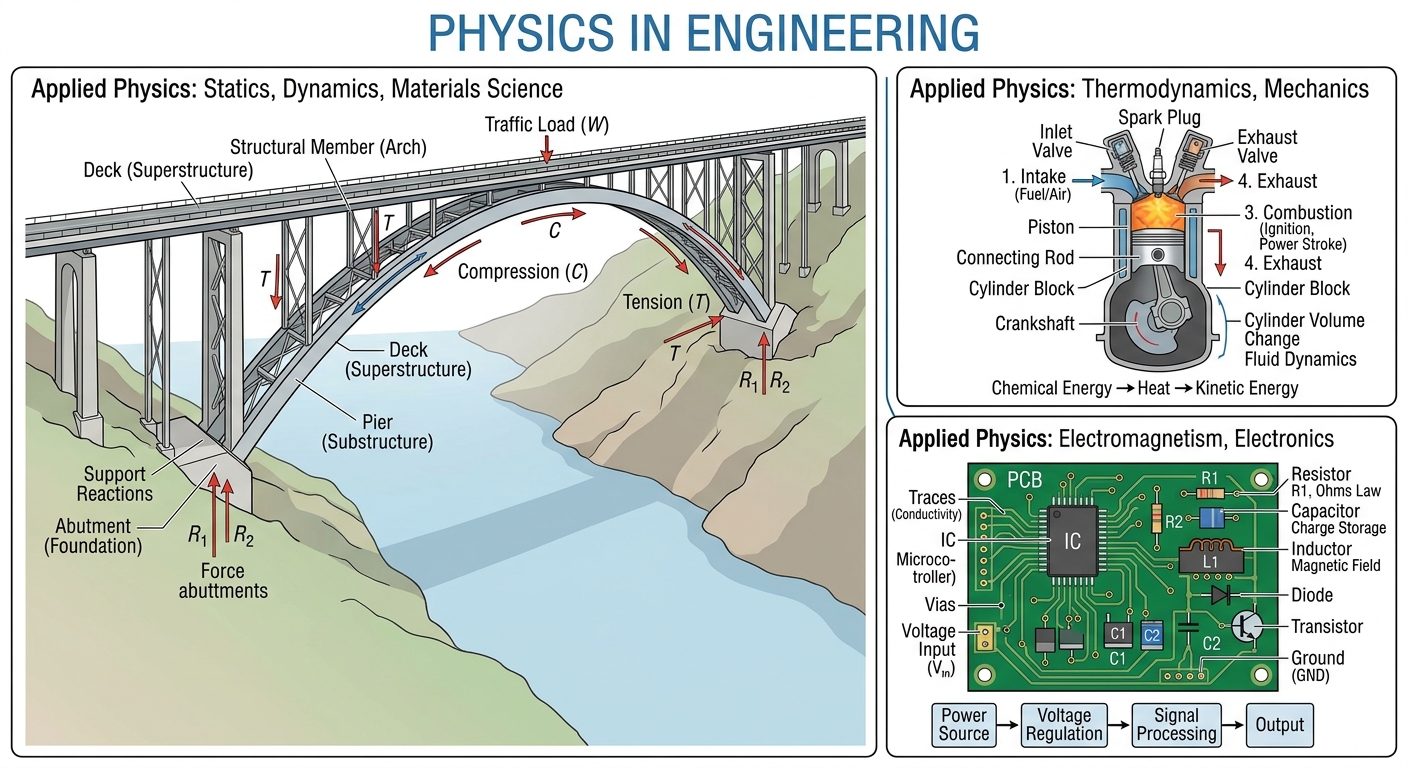
Engineering is the application of scientific and mathematical principles to design, build, and maintain structures, machines, and other systems. Physics forms the backbone of almost all engineering disciplines.
• Structural Engineering: Principles of forces, stress, strain, and stability (e.g., Newton's laws of motion, elasticity) are used to design safe and durable buildings, bridges, and dams. Understanding how materials behave under different loads is crucial.
• Mechanical Engineering: Concepts of motion, energy, heat, and fluid dynamics are applied in the design of engines, vehicles, robots, and manufacturing equipment. For instance, the aerodynamics of an airplane, the efficiency of a car engine, or the operation of hydraulic systems all rely on physics.
• Electrical and Electronic Engineering: The study of electricity, magnetism, and wave phenomena is fundamental to designing circuits, power generation systems, communication devices (like mobile phones and radios), and computers.
• Civil Engineering: Physics principles are used to understand soil mechanics, water flow in pipes, and the effects of weather on infrastructure.
 |
PHYSICS IN ENGINEERING |
✅ Check Your Understanding
Pause here. Let learners attempt these before moving on.
| 1. Quick Recall [1 mark] |
Define a 'physical quantity' and give one example. |
| 2. Apply the Concept [2 marks] |
Explain how the principle of forces is applied in the design of a bridge. |
| 3. Misconception Check |
True or False: Physics is only useful for building rockets and not for everyday items like mobile phones. Justify your answer. |
Answers
1. A physical quantity is a quantity that can be measured. Example: Length, mass, time, temperature.
2. In bridge design, physics principles like gravity, tension, compression, and shear forces are used to calculate the strength required for different parts of the bridge. Engineers ensure the bridge can withstand the weight of traffic, wind, and its own structure without collapsing.
3. False. Physics is fundamental to the design of mobile phones, involving principles of electricity, magnetism, electromagnetic waves for communication, and material science for components.
2. Physics in Medicine
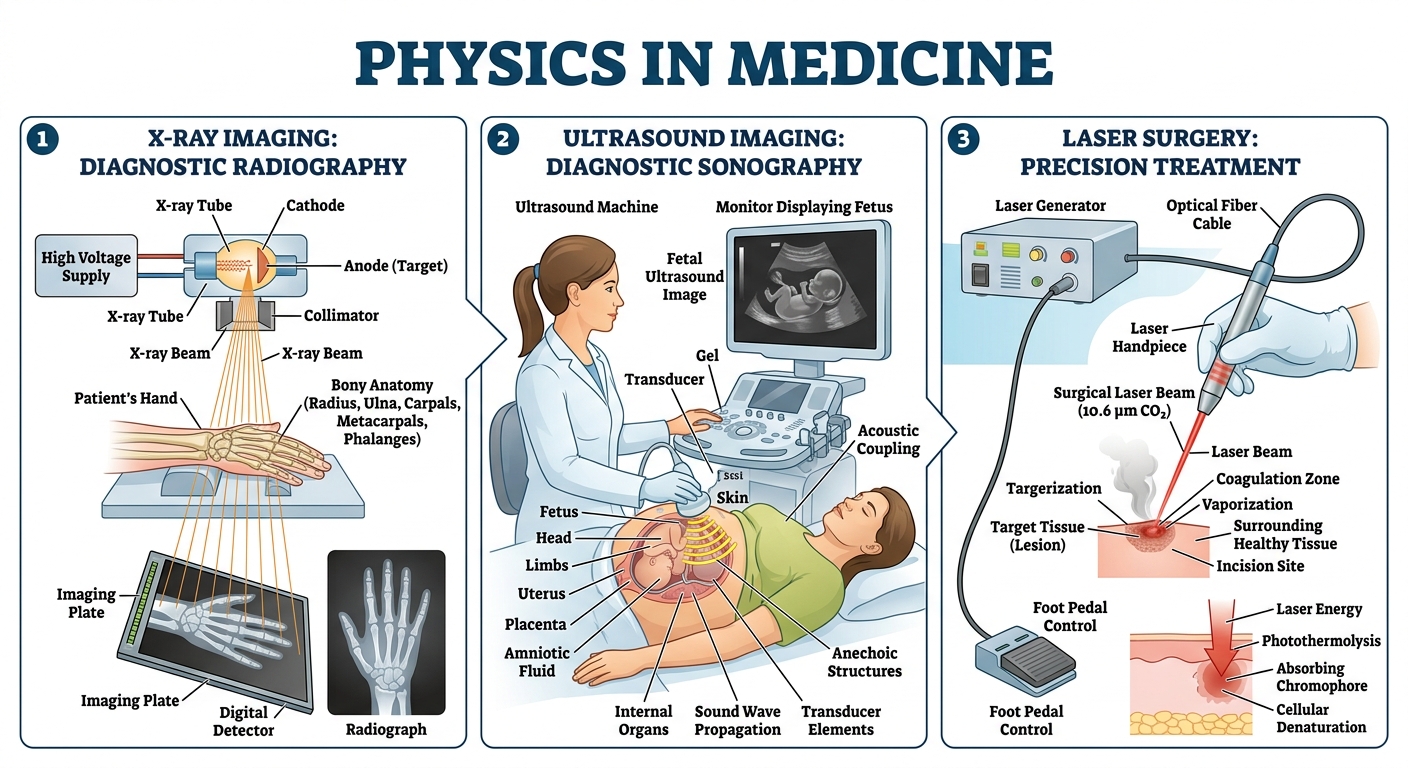
Physics plays a vital role in modern medicine, from diagnosing illnesses to developing advanced treatment methods and understanding the human body.
• Diagnostic Imaging:
* X-rays: Use electromagnetic radiation to create images of bones and internal structures. Physics explains how X-rays are generated and interact with tissues.
* Ultrasound: Uses high-frequency sound waves to create images of soft tissues and organs, especially useful during pregnancy. This relies on the physics of wave propagation and reflection.
* Magnetic Resonance Imaging (MRI): Uses strong magnetic fields and radio waves to produce detailed images of organs, soft tissues, bone, and virtually all other internal body structures. This technology is based on nuclear magnetic resonance, a quantum physics phenomenon.
• Medical Treatment:
* Radiotherapy: Uses high-energy radiation (X-rays, gamma rays) to destroy cancer cells, applying principles of nuclear physics and radiation interaction with matter.
* Laser Surgery: Uses focused beams of light (lasers) for precise cutting, burning, or vaporisation of tissue, relying on the physics of optics and light-matter interaction.
• Medical Devices: Many medical instruments, from simple thermometers and blood pressure monitors to complex pacemakers and dialysis machines, are designed and operate using physics principles.
• Biomechanics: The study of the mechanics of living organisms. It applies physics (especially mechanics) to understand how forces affect the human body during movement, injury, and rehabilitation.
 |
PHYSICS IN MEDICINE |
✅ Check Your Understanding
Pause here. Let learners attempt these before moving on.
| 1. Quick Recall [1 mark] |
Name two medical diagnostic tools that rely on physics principles. |
| 2. Apply the Concept [2 marks] |
Explain how ultrasound creates images of internal body parts. |
| 3. Misconception Check |
True or False: MRI scans use harmful X-rays to see inside the body. Justify your answer. |
Answers
1. X-rays, Ultrasound, MRI (any two).
2. Ultrasound uses high-frequency sound waves that are emitted into the body. These waves reflect off internal structures and return to a sensor. The time it takes for the echoes to return and their intensity are used to create a real-time image of the internal organs and tissues.
3. False. MRI scans use strong magnetic fields and radio waves, not X-rays. This makes them non-ionizing and generally safe, especially compared to X-rays which use ionizing radiation.
3. Physics in Agriculture
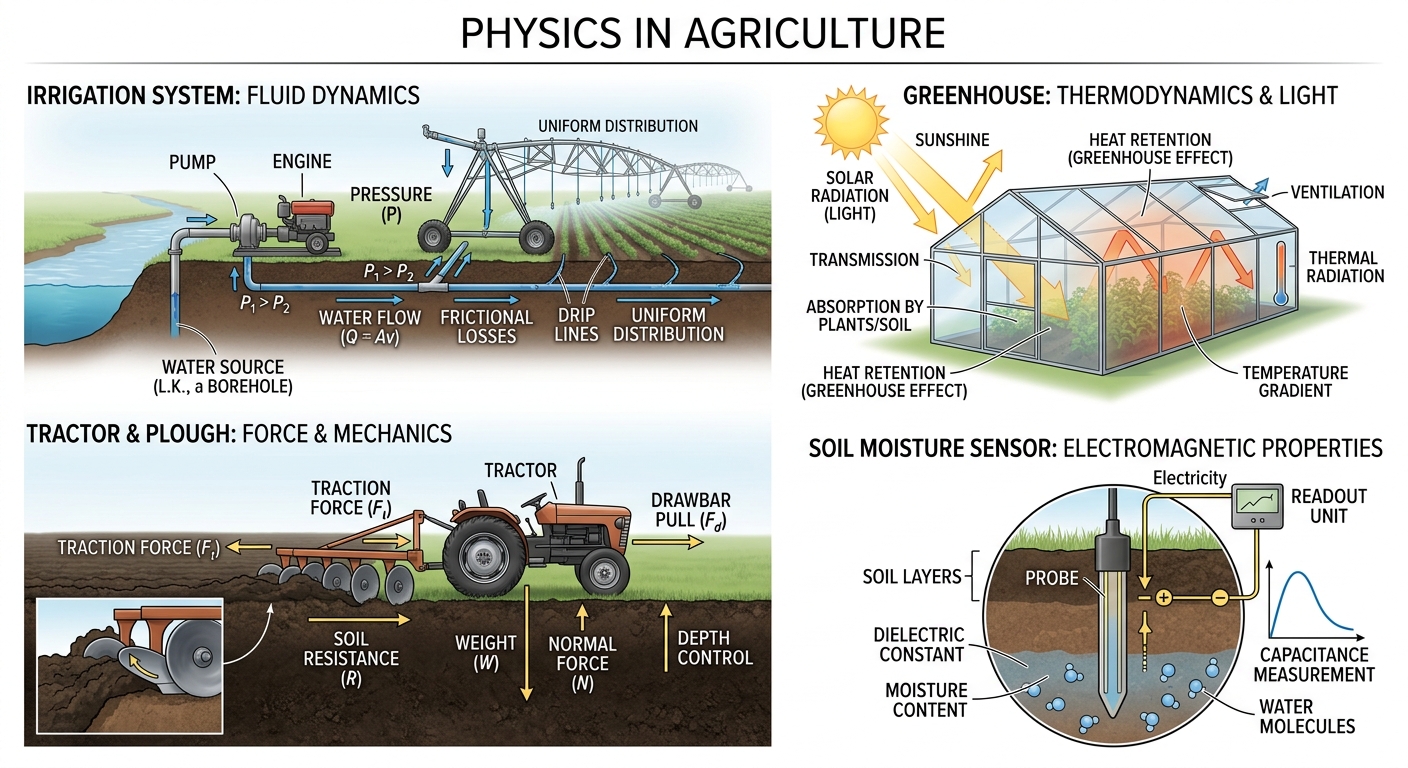
Physics contributes significantly to improving agricultural practices, from soil management to crop production and irrigation.
• Soil Science:
* Soil Density and Porosity: Physics helps measure soil density and porosity, which are crucial for understanding water infiltration, root penetration, and nutrient availability.
* Moisture Sensors: These devices use electrical properties (related to physics of materials) to measure soil moisture content, helping farmers irrigate efficiently and conserve water.
• Irrigation Systems:
* Water Pressure and Flow: Principles of fluid dynamics are applied to design efficient irrigation systems, ensuring water is delivered evenly and effectively to crops. This includes understanding pumps, pipes, and spray patterns.
* Drip Irrigation: This technique uses gravity and pressure to deliver water directly to plant roots, minimizing waste.
• Farm Machinery:
* Tractors and Ploughs: The design and operation of farm machinery rely on mechanical physics principles such as forces, friction, torque, and power. Understanding how these machines interact with the soil is vital for efficient cultivation.
* Harvesting Equipment: Combines and other harvesting machines use mechanical and kinetic energy principles to efficiently gather crops.
• Crop Storage and Climate Control:
* Greenhouses: Utilize principles of heat transfer (radiation, convection, conduction) to create controlled environments for optimal plant growth, protecting crops from harsh weather.
* Refrigeration: Physics of thermodynamics and heat exchange is used in cold storage facilities to preserve harvested crops and reduce spoilage.
• Remote Sensing: Satellites and drones equipped with sensors (using principles of optics and electromagnetism) monitor crop health, soil conditions, and weather patterns over large areas, aiding in precision agriculture.
 |
PHYSICS IN AGRICULTURE |
✅ Check Your Understanding
Pause here. Let learners attempt these before moving on.
| 1. Quick Recall [1 mark] |
Name one physics principle used in designing irrigation systems. |
| 2. Apply the Concept [2 marks] |
Explain how a greenhouse uses physics to help plants grow. |
| 3. Misconception Check |
True or False: Heavy farm machinery like tractors cause more damage to soil because they have wider tyres, which means more pressure on the ground. Justify your answer. |
Answers
1. Fluid dynamics, pressure, gravity, flow rates (any one).
2. A greenhouse uses physics principles of heat transfer. Glass or plastic panels allow sunlight (short-wave radiation) to enter, warming the air and soil inside. The panels then trap the re-radiated heat (long-wave radiation), preventing it from escaping, thus maintaining a warmer temperature for plant growth.
3. False. Wider tyres on heavy farm machinery reduce the pressure exerted on the ground because the weight of the machine is distributed over a larger area. This helps prevent the machinery from sinking into soft soil and reduces soil compaction.
4. Demonstrating the Application of Physics in Everyday Life
Beyond the major sectors, physics principles are at play in countless daily activities.
• Measuring Mass: When you use a kitchen scale to measure the mass of ingredients for cooking, you are applying the principle of gravity and forces. The scale measures the downward force (weight) exerted by the object and converts it into a mass reading.
* Example: A student uses a digital kitchen scale to measure 500 g of maize meal. The scale uses a load cell, which converts the force exerted by the maize meal into an electrical signal that is then displayed as mass.
• Charging a Phone: Every time you plug in your phone to charge, you are utilizing principles of current electricity. The charger converts the alternating current (AC) from the wall socket into direct current (DC) that your phone battery can store. This involves concepts like voltage, current, resistance, and energy conversion within electrical circuits.
• Driving a Bicycle/Car: The motion of these vehicles involves forces (like friction, air resistance, propulsion), momentum, and energy transformations. Pedalling a bicycle converts chemical energy from your body into kinetic energy for movement. Braking uses friction to convert kinetic energy into heat, slowing the vehicle down.
• Using a Light Bulb: When you switch on a light, an electric current flows through a filament (in an incandescent bulb) or gases (in fluorescent lamps), generating light and heat. This demonstrates the conversion of electrical energy into light and thermal energy.
• Cooking Food: Whether boiling water, frying an egg, or baking bread, you are applying principles of heat transfer (conduction, convection, radiation). For example, a metal pot conducts heat from the stove to the food, while boiling water transfers heat through convection currents.
✅ Check Your Understanding
Pause here. Let learners attempt these before moving on.
| 1. Quick Recall [1 mark] |
What physics principle is primarily involved when you measure something's mass on a scale? |
| 2. Apply the Concept [2 marks] |
Describe the energy conversion that occurs when you charge a mobile phone. |
| 3. Misconception Check |
True or False: A phone charger directly transfers the AC electricity from the wall socket to the phone battery. Justify your answer. |
Answers
1. Gravity (or force/weight).
2. When charging a mobile phone, electrical energy from the mains supply is converted into chemical potential energy, which is stored in the phone's battery. Some energy is also converted to heat due to resistance in the charger and phone.
3. False. A phone charger converts the alternating current (AC) from the wall socket into direct current (DC) before supplying it to the phone battery. Phone batteries require DC to charge.
SUMMARY
Physics is not just a subject studied in school; it is an integral part of our daily lives and underlies many of the advancements in modern society. From the sophisticated technology used in engineering and medicine to the practical applications in agriculture and simple everyday activities, physics provides the fundamental principles that explain how things work. By understanding these applications, we can better appreciate the relevance and importance of physics in shaping our world.
ASSESSMENT QUESTIONS
1. Define the term 'physics'. [1 mark]
2. Give two examples of how physics principles are applied in the field of engineering. [2 marks]
3. Name one medical diagnostic technique and explain the physics principle it uses. [2 marks]
4. Describe how knowledge of physics helps farmers manage their irrigation systems effectively. [2 marks]
5. Explain the physics involved when you use a measuring scale to find the mass of an object. [2 marks]
6. List three everyday activities that demonstrate the application of physics. [3 marks]
7. Why is understanding the concept of pressure important in both engineering (e.g., bridge design) and agriculture (e.g., tractor tyres)? [3 marks]
8. A patient needs an imaging scan that does not use ionizing radiation. Which two physics-based diagnostic tools would be suitable? [2 marks]
COMMON DIFFICULTIES & MISCONCEPTIONS
• Physics is only for complex topics: Learners often think physics only applies to advanced concepts like space travel or nuclear power, failing to see its relevance in simple daily tasks.
• Confusing mass and weight: Students might not differentiate that a scale measures weight (a force due to gravity) and then displays it as mass.
• Misunderstanding electricity: Some learners may believe that electricity flows directly from the socket to a device without any conversion or alteration by a charger.
• Ignoring physics in biology/agriculture: Students might compartmentalise subjects and not realise that physics principles underpin biological processes and agricultural technologies.
• Tautological answers: When asked for an example of physics application, some might just state a device without explaining how physics is applied (e.g., "a phone" instead of "a phone uses electricity and electromagnetic waves for communication").
QUICK REFERENCE SUMMARY
Key Applications of Physics
| Engineering |
Design of bridges (forces), car engines (motion, energy), electronics (electricity). |
| Medicine |
X-rays (electromagnetic radiation), Ultrasound (sound waves), MRI (magnetism, radio waves), radiotherapy (nuclear physics). |
| Agriculture |
Irrigation systems (fluid dynamics), farm machinery (forces, mechanics), greenhouses (heat transfer), soil sensors. |
| Everyday Life |
Measuring mass (gravity), charging phones (electricity), driving (motion, forces), cooking (heat transfer), light bulbs (electricity, light). |
Figure: Summary of key applications of physics